1. Tariff Threat Sends Shockwaves Through the Great Lakes Basin
A proposal to levy 50 percent tariffs on Canadian automotive exports has triggered deep concern across corporate offices in Detroit, Windsor, and Toronto. As reported by The Etownian, industry stakeholders warn that border duties on this scale would cripple auto manufacturing across the region. The cross-border corridor operating along Ontario Highway 401 and Interstate 75 depends on frictionless trade. A tariff of this magnitude shatters the commercial model that has anchored continental vehicle assembly since the 1965 Auto Pact.
Industry executives do not view the proposed tariff as a standard trade dispute. They see it as an operational shutdown. Modern vehicle assembly requires parts to move without delay. Engines cast in Ohio go to Ontario for machining, return to Michigan for drivetrain installation, and cross back into Canada for final assembly. A 50 percent duty anywhere along this route wipes out operating margins for Tier-1 suppliers. Plants would idle within forty-eight hours.
The automotive sector accounts for over $100 billion in annual two-way trade between the United States and Canada. Production facilities in Oshawa, Oakville, Windsor, and Cambridge rely on American component imports. At the same time, American assembly lines need Canadian transmissions, stampings, and software modules. If these tariffs take effect, industry analysts estimate North American light-vehicle production would drop by roughly 1.5 million units in the first year.
2. Logistics Gridlock Looms for Ambassador Bridge and Rail Arteries
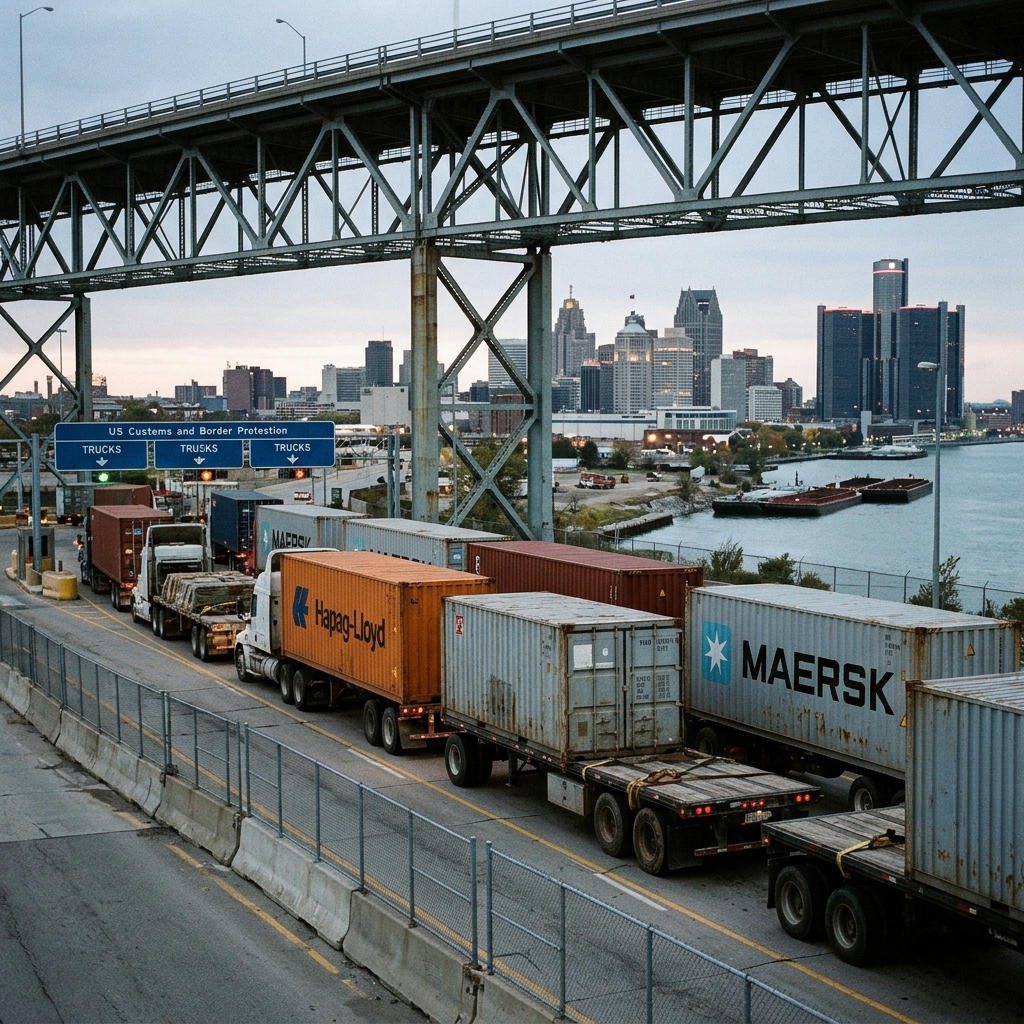
The logistics infrastructure at the border cannot handle an import duty of this size. U.S. Customs and Border Protection and the Canada Border Services Agency clear thousands of commercial trucks every day across the Ambassador Bridge and the Blue Water Bridge. This freight moves through automated clearance systems under the Free and Secure Trade program. Imposing punitive tariffs would force detailed tariff classification reviews. Trucks would stall at checkpoints, creating backups that stretch for miles into Ontario and Michigan.
Rail carriers like CPKC and CN Rail move finished vehicles and heavy components through dedicated rail tunnels beneath the Detroit and St. Clair rivers. These rail networks run on strict schedules measured in hours. If customs brokers must secure large tariff bonds before cargo enters U.S. territory, working capital requirements will surge. Smaller transport operators simply lack the cash reserves to finance tariff liabilities while shipments wait for clearance.
Parts distribution centers across the Midwest would run dry quickly. Major manufacturers keep less than two days of safety stock for critical stampings and electronic modules. When parts stall at the border, assembly lines stop. The fallout would spread quickly beyond auto plants into industrial chemicals, plastics, and precision metals, hitting regional manufacturing output hard.
3. Legal Violations Confront USMCA Rules of Origin
A unilateral 50 percent tariff directly breaches the United States-Mexico-Canada Agreement. Under Chapter 4 and Chapter 5 of the pact, passenger vehicles that meet a 75 percent Regional Value Content threshold enter member countries duty-free. Imposing arbitrary 50 percent border taxes bypasses negotiated trade terms and invites formal dispute settlement procedures under Chapter 31 of the USMCA. Trade attorneys in Ottawa have already drafted retaliatory options targeting American industrial goods.
The dispute would fracture cross-border trade administration. If Washington invokes emergency economic powers to sidestep the USMCA, Canada would likely match the move with retaliatory tariffs on American auto parts, agricultural goods, and machinery. The Canadian Department of Finance could target vehicles built in southern U.S. plants, cutting off access to Canada, which remains the top export market for American-built vehicles. The integrated continental market would split into separate national segments.
Institutional investors are already adjusting credit pricing across the automotive supply chain. Rating agencies have placed multiple auto parts suppliers on credit watch with negative implications. These suppliers operate with thin cash reserves and heavy capital commitments for electric vehicle retooling. A sudden drop in revenue caused by tariffs would breach debt covenants, pushing vulnerable suppliers toward insolvency and disrupting primary automakers.
4. Long-Term Capital Flight and Market Fallout
Consumers will bear the brunt of cross-border trade barriers. The average transaction price for a new vehicle in North America sits near $48,000. If tariffs add 50 percent to the value of imported Canadian vehicles, showroom prices will jump by thousands of dollars within weeks. Used-vehicle markets would absorb the excess demand, lifting used car prices and keeping inflation persistent across both the U.S. and Canada.
Central banks would face an awkward policy dilemma. The Bank of Canada and the Federal Reserve are trying to cool inflation without causing a downturn. A supply shock in the automotive sector cuts industrial productivity, shrinks payrolls, and drives up consumer prices at the same time. This combination threatens stagflation across manufacturing hubs in Ontario, Michigan, Ohio, and Indiana.
Corporate planners cannot commit multi-billion dollar capital budgets when trade policies change without warning. If existing trade treaties can be set aside through tariff threats, long-term capital for battery plants, plant modernization, and software development will leave North America. Automakers will direct investment toward stable, self-contained domestic markets overseas rather than risk capital along the U.S.-Canada border.