1. Department of Finance Extends Targeted Import Relief
OTTAWA. The Canadian federal government has renewed targeted tariff relief orders on select American goods, blunting an impending cost spike for domestic processors and equipment manufacturers. The Department of Finance confirmed the measure following consultations with national trade associations, steel buyers, and industrial parts distributors. Without this administrative extension, standard Most-Favoured-Nation tariff schedules or retaliatory surcharges would have snapped back into place. That outcome threatened to disrupt operations for Canadian companies that rely exclusively on American suppliers for intermediate industrial compounds, advanced alloys, and agricultural components.
The relief mechanism operates through targeted customs tariff remission orders overseen by the Canada Border Services Agency (CBSA). Canadian industrial purchasers demonstrated that alternative domestic supply does not exist in commercial quantities, meeting statutory exemption criteria under Section 115 of the Customs Tariff act. Importers had warned that higher border levies would raise procurement expenses across Ontario and Quebec manufacturing hubs by 6 to 12 percent. By renewing the exemption, Ottawa protects Canadian gross margins in automotive assembly and capital equipment manufacturing while inflation prints remain above the Bank of Canada target.
Cross-border commerce across the 49th parallel relies heavily on intra-firm transfers. American intermediate parts cross the border multiple times before emerging as finished vehicles, farm machinery, or processed foods. Imposing or allowing duties to lapse on these critical components causes immediate bottlenecks. Trade policy analysts in Washington and Ottawa view this move as a pragmatic economic defense. Prime Minister Justin Trudeau's cabinet chose targeted stability over tariff confrontation, balancing domestic supply security against the broader political pressures of North American trade management.
2. CBSA Enforcement and Corridor Flow Along Blue Water and Ambassador Bridges
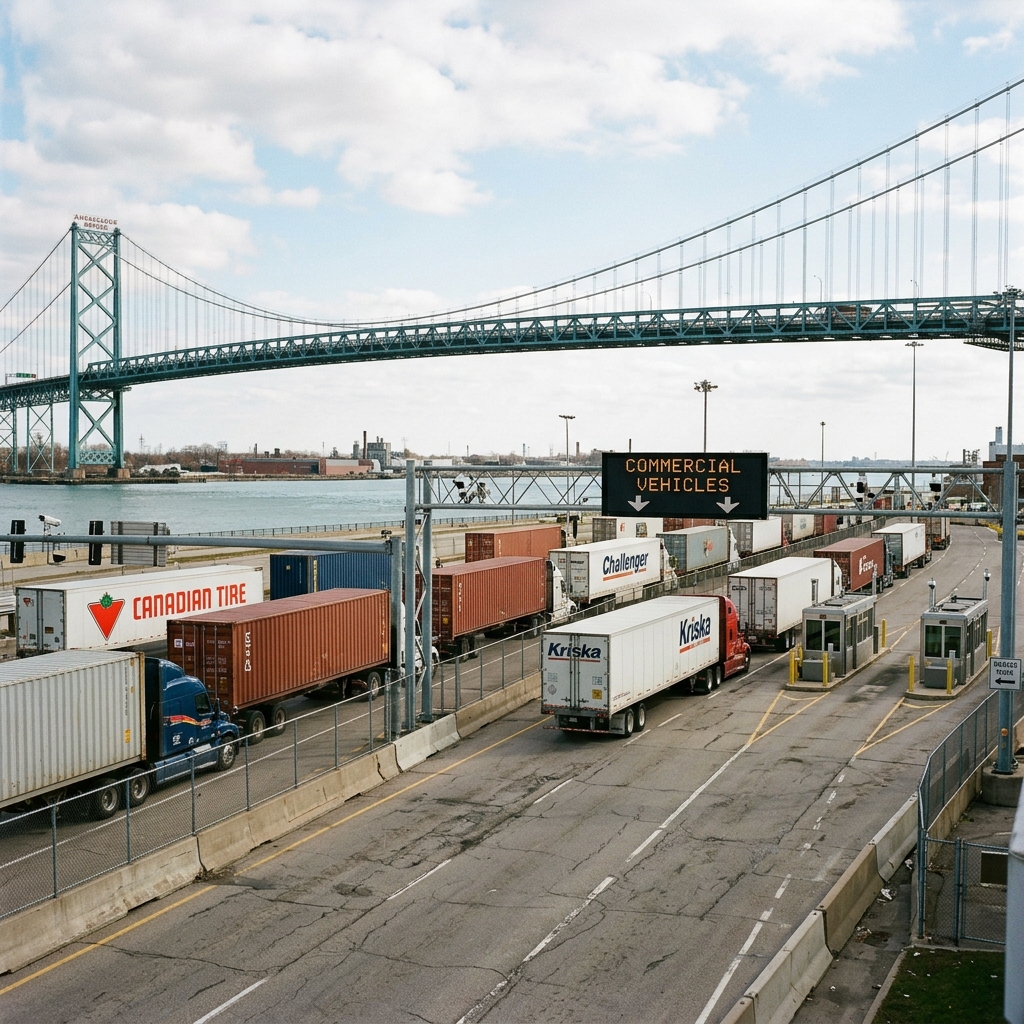
The administrative reprieve brings relief to commercial dispatchers and freight forwarders operating across the Windsor-Detroit and Sarnia-Port Huron corridors. The Ambassador Bridge and the Blue Water Bridge handle more than 40 percent of total bilateral truck trade by value. At these high-volume commercial crossings, reclassifying Harmonized System tariff codes creates severe administrative friction. Border officers at CBSA commercial booths require verified exemption certificates from importers to wave freight through under duty-free codes, avoiding secondary inspections and prolonged hold times at primary inspection lines.
Logistics operators running freight through Canadian Pacific Kansas City (CPKC) and Canadian National (CN) intermodal yards also track these exemptions closely. Rail lines moving bulk chemicals, industrial plastics, and steel coils out of Ohio, Indiana, and Pennsylvania into the Greater Toronto Area face steep demurrage fees if customs clearance stalls. The remission order prevents hundreds of freight bills from incurring surprise border assessments. Customs brokers handling daily electronic entries through CBSA's Assessment and Revenue Management (CARM) system can now execute filings under steady rules.
Industrial buyers spent the final quarter of the year calculating worst-case scenarios. Many corporate procurement directors prepared inventory drawdowns or expensive alternative routings. In the chemicals sector alone, specialty solvents produced in Texas and Louisiana refineries have no near-term substitutes in Alberta or Sarnia. Ottawa's policy renewal removes this capital drag. Financial officers at Canadian manufacturing firms can preserve working capital rather than tying up millions of dollars in customs bond guarantees and deferred duty escrow accounts.
3. Supply Chain Mechanics and the Industrial Cost Calculation
The economic logic behind the tariff reprieve rests on cost discipline within domestic fabrication plants. Canadian manufacturers face higher borrowing costs as the Bank of Canada manages its policy rate, forcing operations teams to cut unit costs. If CBSA had collected the suspended tariffs, processors would have absorbed the duties or passed them downstream to commercial builders and consumer goods distributors. Neither option worked in an economy characterized by sluggish capital investment and thin gross margins.
Specific categories covered under the extended remission include specialized cold-rolled steel, custom plastic extrusions, and advanced fluid control valves used in commercial refrigeration. These products represent high-specification items manufactured by small clusters of US industrial firms in the Midwest. Because Canadian steelmakers like Stelco and Algoma focus primarily on standard flat-rolled and structural shapes, domestic buyers cannot source these specialty grades locally. An import duty on such inputs acts as a punitive tax on the Canadian buyer rather than an incentive to buy domestic alternatives.
Cross-border industry associations, including Canadian Manufacturers and Exporters (CME), lobbied cabinet ministers directly for this policy continuation. Their economic modeling showed that unmitigated duty collection would have cost the domestic industrial sector more than 180 million Canadian dollars annually in direct levies and compliance costs. The Department of Finance opted to forgo this tariff revenue to avoid damaging output and job growth in automotive, energy services, and value-added agricultural sectors.
4. Bilateral Politics Ahead of the 2026 USMCA Joint Review
This quiet administrative action reflects broader diplomatic preparation for the required 2026 joint review of the United States-Mexico-Canada Agreement. Both Washington and Ottawa are managing sensitive bilateral issues, including Canadian digital services taxes, US dairy export quotas, and cross-border steel tracking. By avoiding unprovoked duty spikes on American industrial goods, Ottawa prevents retaliation from the Office of the United States Trade Representative (USTR). Canadian trade negotiators need to demonstrate commitment to open supply corridors as US political figures threaten across-the-board tariffs.
Cross-border policy experts in Washington note that targeted import relief is an effective defense against protectionist sentiment in the US Congress. American equipment manufacturers and steel fabricators depend heavily on Canadian commercial clients for sales volume. When Canadian buyers purchase these goods duty-free, it preserves business activity in critical industrial states like Michigan, Ohio, and Pennsylvania. This interdependence gives Canadian diplomats valuable leverage when defending North American supply chain integration before congressional committees and the US International Trade Commission.
Corporate executives on both sides of the border should treat this tariff reprieve as an interim measure rather than permanent policy. The USMCA sunset review in 2026 will bring intense political scrutiny to all tariff preferences and rules of origin thresholds. Trade directors must monitor regulatory dockets from both the CBSA and US Customs and Border Protection (CBP). Companies must audit their origin documentation, maintain accurate tariff classifications, and stress-test their supply chains against potential revisions to trade rules over the next twenty-four months.