1. Canada Recalls Trade Team After Washington Talks Collapse Over Auto Rules and Dairy Quotas
Canada's chief trade negotiator, Kirsten Hillman, ordered her delegation back to Ottawa late Thursday. The move came after three days of closed-door sessions at the US Trade Representative's office failed to produce movement on two core files: automotive rules of origin and dairy tariff-rate quotas. Two officials with direct knowledge of the talks said USTR Katherine Tai's team rejected Canada's proposal to phase in a 75 percent regional value content threshold for battery-electric vehicles over five years. The US side insisted on immediate compliance. The Canadian side called the demand unworkable for Stellantis and Ford plants in Windsor and Oakville.
The recall is not a routine procedural pause. Hillman's team had booked conference rooms at the USTR through Friday and had scheduled a working dinner with Deputy USTR Jayme White. That dinner was cancelled at 4:15 p.m. Wednesday. By Thursday morning, the Canadian delegation had surrendered its visitor badges and boarded a 2 p.m. Air Canada flight to Ottawa. A senior Canadian official described the mood as 'disciplined frustration.' The official added that Ottawa will not negotiate against a self-imposed deadline while the US side treats USMCA review as a one-way exercise.
The immediate trigger was a US proposal circulated Tuesday. It would require automotive parts suppliers to verify North American content at the component level, not the vehicle-assembly level. That change would hit Magna International and Linamar, two Ontario-based parts giants that ship across the Ambassador Bridge daily. Canada's counteroffer, which would have allowed assembly-level averaging through 2027, was rejected without counter. Hillman's recall followed a 45-minute call with Prime Minister Mark Carney's office, according to two people briefed on the conversation.
2. Loonie Slips 0.4 Percent as Traders Price In Prolonged Tariff Uncertainty
The Canadian dollar weakened to 1.3720 against the greenback in Thursday afternoon trading, down 0.4 percent on the day. Currency desks in Toronto and New York priced in a higher probability of retaliatory tariffs on US agricultural goods. The Bank of Canada's overnight rate remains at 2.75 percent, but swaps markets now show a 38 percent chance of a 25-basis-point cut at the June meeting, up from 22 percent a week ago. That repricing reflects fears that a trade spat would shave 0.3 to 0.5 percentage points off Canadian GDP growth in the second half of 2025.
Equity markets told a more granular story. The S&P/TSX Composite fell 0.6 percent, led by a 2.1 percent drop in Magna International and a 1.8 percent decline in Canadian National Railway. In New York, Ford and General Motors each lost less than 1 percent. That suggests investors see the dispute as a Canadian supply-chain problem rather than a US demand shock. The spread between Canadian and US 10-year bond yields widened to 82 basis points, the widest since January, as traders moved money into US Treasuries.
The Canada Border Services Agency has not issued new inspection directives. But customs brokers on the Windsor-Detroit corridor report a noticeable uptick in secondary inspections for automotive parts shipments since Monday. One broker at the Blue Water Bridge in Sarnia said CBP officers have begun requesting component-level documentation for aluminum castings, a change that adds four to six hours per load. Neither CBP nor CBSA would confirm a policy shift. The Canada Revenue Agency, meanwhile, has reminded exporters that GST/HST zero-rating for cross-border freight remains unchanged. That is a signal Ottawa is not yet weaponizing tax administration.
3. USMCA Chapter 31 Panel Looms as Ottawa Prepares Dairy Retaliation List
Canada's next move is likely a formal request for a USMCA Chapter 31 dispute panel on dairy tariff-rate quotas. The office of International Trade Minister Mary Ng has prepared a 14-page draft complaint, according to a government official who reviewed the document. The complaint alleges that the US has failed to comply with the 2023 panel ruling that found American dairy exporters were denied fair access to Canada's TRQ system. That ruling already authorized Canada to impose retaliatory tariffs on $1.1 billion of US goods, but Ottawa has held the list in abeyance to avoid inflaming negotiations. The recall changes that calculus.
The dairy file is a political tripwire in both capitals. US dairy cooperatives in Wisconsin and New York have lobbied Tai's office for months to hold the line on Canada's supply management system. Canada's Dairy Farmers of Ontario and Les Producteurs de lait du Québec have equally pressed Ng to defend the TRQ allocation model. A Chapter 31 panel would take six to nine months to render a decision. But the mere filing would freeze any goodwill built during the past year of quiet talks. It would also complicate the USMCA's 2026 joint review, which both governments had hoped to use as a reset moment.
Automotive rules of origin remain the harder problem. The USMCA requires 75 percent regional value content for vehicles, but the US wants to count only components assembled in North America, not just sourced from the region. Canada argues that the current assembly-level calculation is the only workable method for battery supply chains that rely on Canadian nickel and cobalt but process those minerals in Asia. A US official close to the talks said the American side views Canada's position as a delay tactic. 'They want to run out the clock until 2026,' the official said. 'We are not going to let that happen.'
4. Freight Corridors and Auto Plants Face a Summer of Uncertainty as Both Sides Dig In
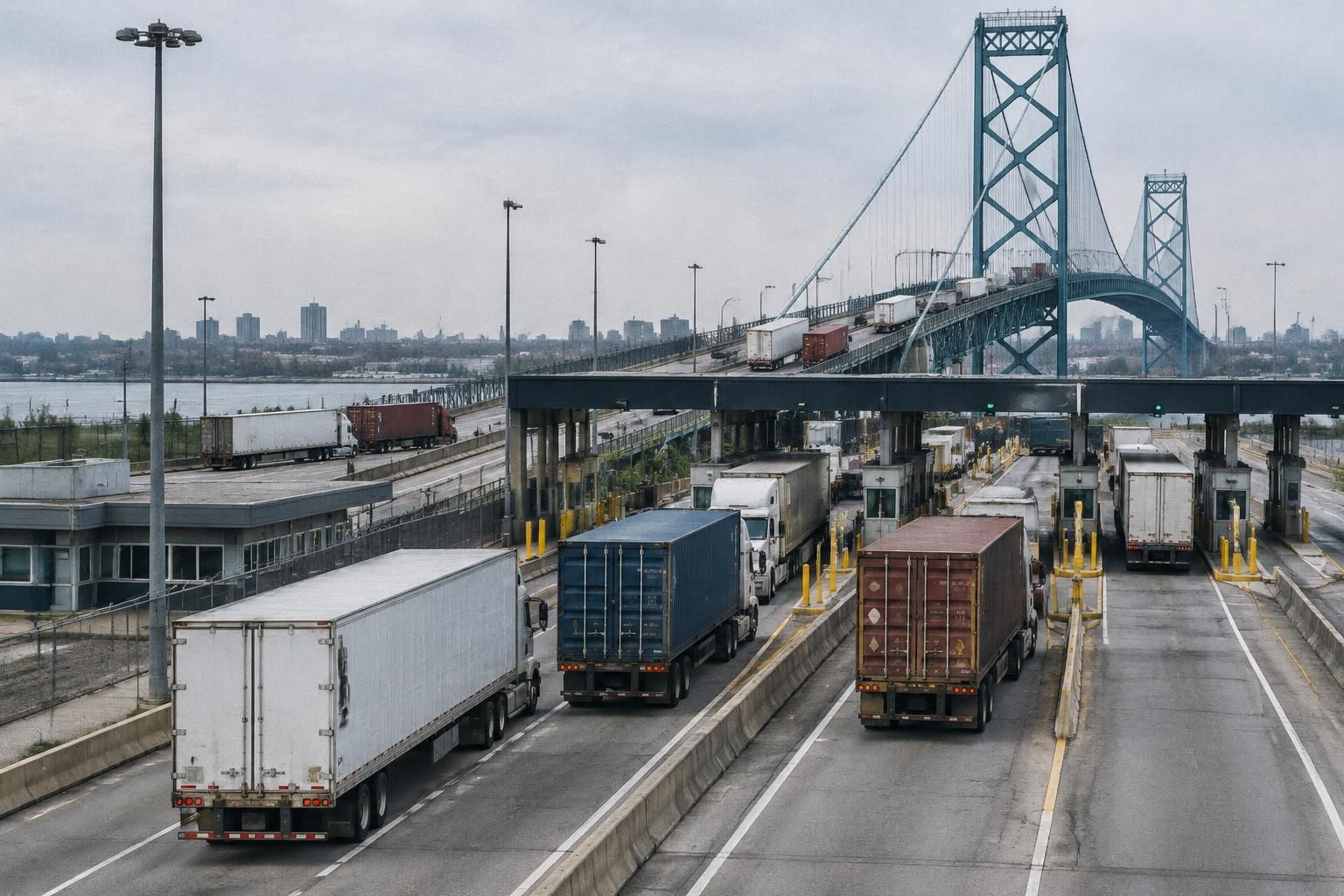
The operational impact will be felt first on the Ambassador Bridge, which carries roughly 8,000 trucks per day and $400 million in goods. If Canada retaliates with tariffs on US agricultural products, Michigan cherry growers and Wisconsin dairy processors would face a 10 percent levy at the border. That would prompt reciprocal US action against Canadian beef and pork. The CPKC rail network, which moves automotive parts between Kansas City and Toronto, has already built a 48-hour buffer into its schedules. A CPKC dispatcher in Moose Jaw said the railroad is 'planning for the worst and hoping for a phone call.'
For Canadian auto assemblers, the breakdown means no clarity on capital allocation for 2026 model-year tooling. Ford's Oakville plant, which is retooling for electric vehicle production, needs a stable rules-of-origin framework to finalize battery sourcing contracts with Korean and Japanese suppliers. Stellantis's Windsor assembly plant has similar exposure. The Canadian Vehicle Manufacturers' Association has asked Ottawa for a 90-day grace period on any new documentation requirements. No decision has been made. A senior industry official said the recall 'turns a negotiating problem into a planning problem.'
The Pacific Gateway corridor, which handles 25 percent of Canada-US container traffic through the Port of Vancouver and Prince Rupert, faces less immediate risk because most of that trade is destined for Asian markets. But the broader signal matters. When Canada recalls its negotiators, it tells the market that the bilateral relationship is entering a cooler phase. The last time Ottawa pulled a trade team from Washington was in 2018, during the NAFTA renegotiation. That recall lasted 11 days. This one has no scheduled return date.