Mark Carney Signals Momentum in High-Stakes Bilateral Economic Consultations
Mark Carney confirmed that Canadian and American trade officials are advancing toward common ground on cross-border market access, according to an interview published by The Washington Post. The former governor of both the Bank of Canada and the Bank of England has assumed a central advisory role for the federal government in Ottawa. His direct participation signals a shift toward institutional financial diplomacy as Ottawa prepares for aggressive industrial and tariff posture from Washington. Canadian officials want to lock down concrete trade understandings before tariff rhetoric converts into executive orders that could disrupt 3.6 billion dollars in goods crossing the frontier every day.
Carney indicated that both capitals recognize the shared vulnerabilities embedded within deeply integrated industrial sectors. Canada sends over 75 percent of its merchandise exports to the United States. Nearly 60 percent of American exports to Canada consist of intermediate inputs that Canadian factories process and send back south. The discussions focus on carving out protective exemptions for integrated manufacturing corridors. The dialogue does not replace formal state-to-state channels through Global Affairs Canada and the Office of the United States Trade Representative. Instead, it creates an executive backchannel to resolve sticky issues outside public political theater.
The timing of these statements matches mounting anxiety across Canadian corporate suites. Institutional investors have widened the risk premium on Canadian debt issues due to threats of universal baseline import tariffs. Private capital expenditures across Ontario and Alberta have stalled while corporate treasurers await clarity on cross-border logistics. Carney emphasized that current talks aim to turn generalized trade friction into structured technical agreements. Negotiators are addressing specific compliance mechanisms, labor enforcement standards, and rules of origin that satisfy congressional committees and the White House trade policy apparatus.
Automotive Supply Chains and the 2026 USMCA Joint Review Architecture
At the core of the cross-border discussions is the automotive sector, which accounts for tens of thousands of manufacturing jobs clustered around the Great Lakes corridor. Under Chapter 4 of the United States-Mexico-Canada Agreement, passenger vehicles must meet a 75 percent regional value content threshold to qualify for duty-free treatment. A previous dispute panel ruled against the United States regarding the methodology for calculating regional content, but Washington has resisted full implementation of that panel report. Carney indicated that negotiators are now working on pragmatic formulas that satisfy American domestic content targets without upending parts production in Windsor and Oshawa.
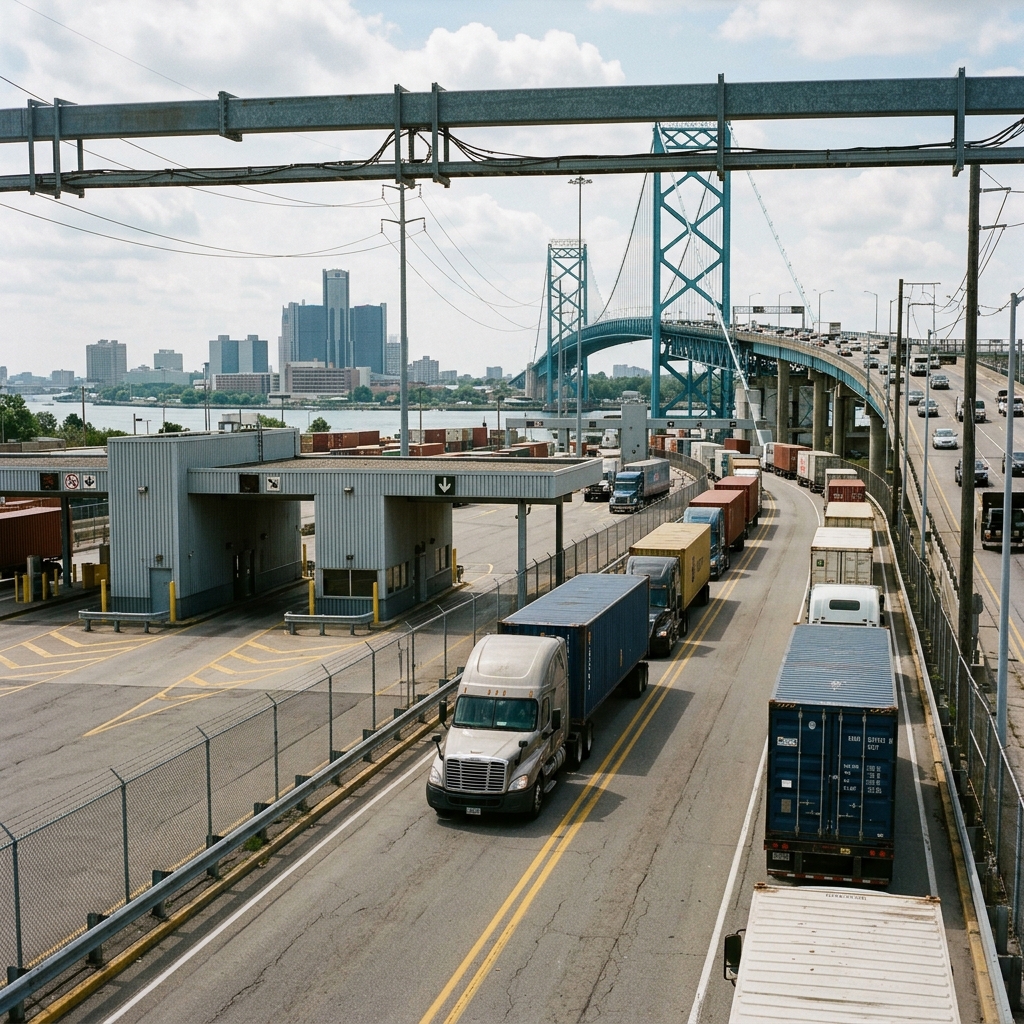
Freight logistics across the Ambassador Bridge and the Blue Water Bridge rely on rapid parts delivery. Motor vehicle assemblies often cross the Detroit River six times during production before a finished vehicle rolls into a dealership. Imposing sudden 10 or 25 percent tariffs on these intermediate components would halt assembly lines in Michigan, Ohio, and Ontario within 48 hours. Transport operators like the Canadian Pacific Kansas City rail network have structured their capital spending around integrated tripartite commerce. Negotiators are drafting supply chain guarantees that shield these freight corridors from retaliatory border levies.
These technical negotiations serve as direct groundwork for the scheduled July 2026 USMCA joint review. Article 34.7 of the pact stipulates that all three member nations must meet to confirm their intention to extend the agreement for another 16-year term. Failure to reach unanimous consent triggers rolling annual reviews that degrade business confidence and freeze long-term capital investments. Carney framed the current talks as a necessary runway to ensure the 2026 formal review proceeds as a technical renewal rather than a destabilizing trade confrontation.
Regulatory Friction Over Digital Services Taxes and Energy Transmission Corridors
Progress in the discussions remains contingent on resolving sharp disputes over digital commerce and agriculture. The Office of the United States Trade Representative has repeatedly objected to Canada's three percent Digital Services Tax, which the Canada Revenue Agency enforces on large foreign technology firms. American trade officials argue the measure discriminates against American multinational platforms and violates national treatment obligations under USMCA Chapter 15. Carney suggested that Canadian negotiators are open to harmonized taxation models if the United States offers clear exemptions for Canadian primary metals and critical minerals.
Agricultural disputes continue to generate friction within the bilateral relationship. Washington continues to pursue formal challenges against Canadian dairy tariff-rate quotas, arguing that the Canadian Dairy Commission restricts access for American processors. USMCA dispute panels have twice reviewed American complaints regarding quota allocations. Canadian negotiators maintain that supply management remains non-negotiable for domestic political reasons. Carney and his advisory peers are seeking compensatory trade concessions in industrial energy supplies and petrochemical inputs to settle the dairy standoff without sacrificing foundational Canadian agricultural statutes.
Energy corridors provide Canada with substantial leverage during these trade exchanges. Crude oil shipments through Enbridge Line 5 and the newly expanded Trans Mountain pipeline provide essential feedstock to refineries throughout the American Midwest and Puget Sound. Hydro-Quebec supplies baseload renewable power to New England utilities through dedicated high-voltage direct current lines. Carney pointed to this energy integration as a model for future cooperation. Canadian negotiators are offering formal resource security pacts covering uranium, lithium, and rare earth elements in exchange for American guarantees against broad industrial import tariffs.
Central Bank Divergence and Capital Flow Implications for Cross-Border Freight
Macroeconomic conditions complicate the policy backdrop as the Bank of Canada and the Federal Reserve pursue divergent monetary paths. Tiff Macklem lowered the Bank of Canada overnight policy rate more aggressively through late 2024 to combat domestic consumer weakness and rising mortgage renewals. The Federal Reserve maintained higher policy rates to suppress lingering domestic services inflation. This monetary policy spread widened the gap between the two currencies, driving the Canadian dollar down toward the 70-cent mark against the greenback. A weak Canadian currency inflates the cost of imported machinery and intermediate equipment from American suppliers.
Cross-border shippers and logistics operators face direct operational margin compression from currency swings and regulatory delays. Commercial carriers passing through border facilities managed by the Canada Border Services Agency and U.S. Customs and Border Protection face rising administrative expenses. Compliance with custom border automation, pre-clearance programs, and carbon disclosure standards requires sustained capital spending. Trucking fleets operating between Ontario and the American Midwest operate on net profit margins near three percent. Any border tariff or inspection delay destroys profitability for regional carriers.
Carney's public confirmation of trade progress offers institutional capital markets a measure of short-term stability. Cross-border mergers and acquisitions, commercial paper issuance, and direct industrial real estate investments depend on predictable access to the American consumer base. Ottawa must show that it can protect access to the American market while preserving regulatory autonomy over taxation, cultural industries, and energy policy. The bilateral negotiations will test whether technical diplomacy can prevail over protectionist domestic politics on both sides of the border.