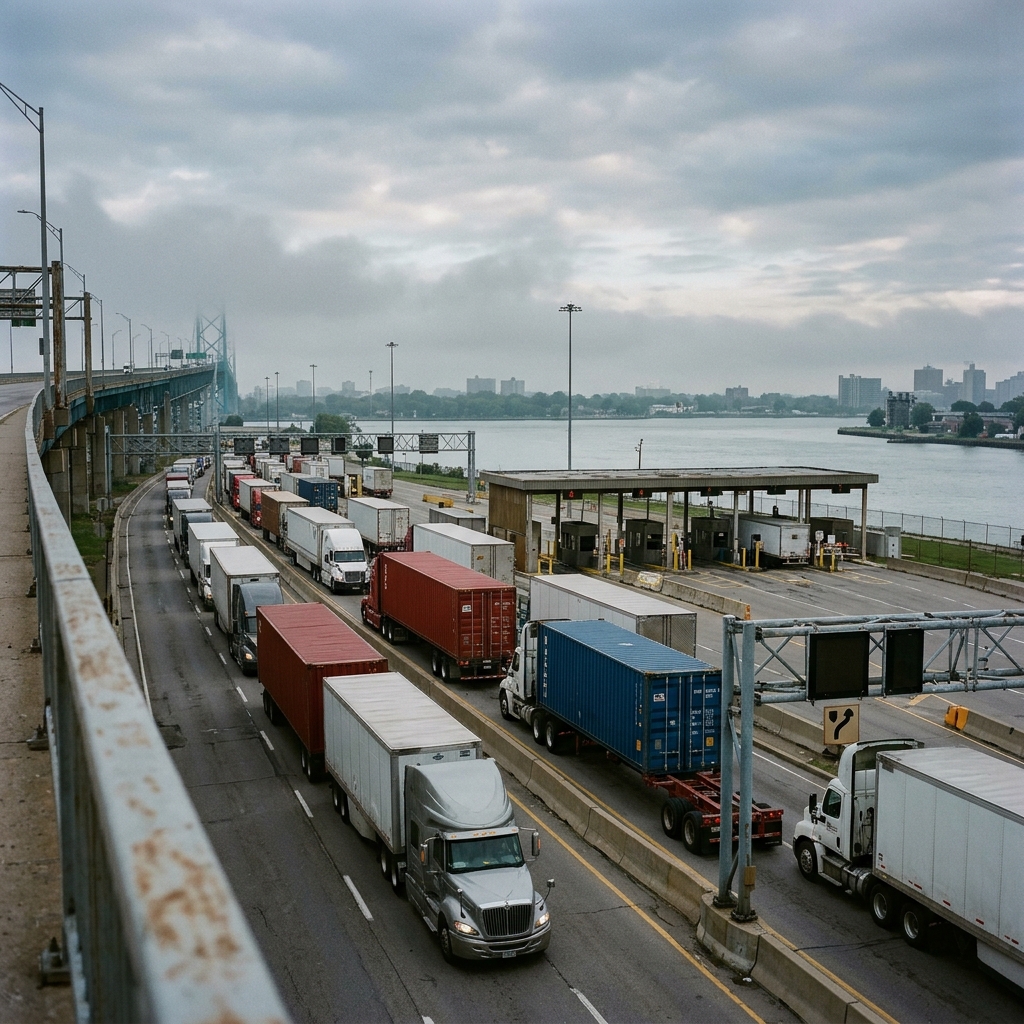
1. Tariff Enforcement Begins Along the Northern Freight Corridors
United States Customs and Border Protection officers began collecting new tariffs on Canadian industrial goods at 12:01 a.m. Tuesday. The fallout hit the Ambassador Bridge and the Blue Water Bridge in Michigan and Ontario immediately. Long-haul truckers faced clearing delays of up to four hours as automated entry systems processed updated Harmonized Tariff Schedule codes. Fleet operators were hit with sudden cash bond demands on shipments that moved duty-free under standard USMCA rules just two days ago. Dispatchers halted unassigned loads across Windsor and Sarnia to avoid unplanned border tax liabilities.
The enforcement covers primary metals, fabricated components, and intermediary petrochemicals from Ontario, Quebec, and Alberta. EnergyNow sources confirmed that the new schedule imposes ad valorem duties between 10 percent and 25 percent on specific cross-border product lines. Logistics hubs in Detroit and Buffalo saw prompt cancellations from mid-sized suppliers unable to absorb the overnight cost jump. Automotive and structural steel buyers spent the morning parsing existing delivery-duty-paid contracts to determine which side must legally foot the import bill.
Corporate legal teams spent hours reviewing force majeure clauses. For decades, manufacturers ran the forty-ninth parallel as an internal logistics line rather than a fiscal boundary. That operational certainty vanished the moment border scanners logged the new duties. Canadian Pacific Kansas City and Canadian National began holding selected rail containers at crossings in Minnesota and North Dakota. Rail operators demanded proof of customs payment guarantees before dispatching trains deeper into the United States.
2. Bank of Canada and Federal Reserve Diverge on Inflation Shocks
The monetary policy shock rippled through trading desks in Toronto and New York within minutes. The Canadian dollar dropped 85 basis points against the US dollar in early trading, testing multi-year lows. Foreign exchange desks moved quickly to price in a steep drop in Canada's terms of trade. The Bank of Canada faces a direct dilemma. Rising import costs for US machinery pressure domestic business spending, while a weaker loonie feeds fresh inflation into domestic food and consumer goods markets.
The Federal Reserve faces a different problem: higher input costs for American manufacturers relying on imported raw materials. US factories buy nearly half of Canada's exported primary aluminum and high-grade billet steel. Domestic mills in Ohio and Pennsylvania cannot replace those volumes overnight. Primary Wall Street dealerships estimate the duties will add 15 to 30 basis points to US headline producer prices within two quarters. That outcome complicates the Federal Open Market Committee's plan to normalize interest rates.
Bond markets responded by widening the yield spread between Government of Canada ten-year benchmark bonds and US Treasuries. Investors demanded larger risk premiums on Canadian corporate debt exposed to border trade barriers. Treasurers in Calgary and Montreal shelved planned commercial paper sales until the full scope of the duties becomes clear. Credit rating agencies warned that prolonged tariffs could lead to negative outlook revisions for Canadian exporters reliant on the northern US manufacturing belt.
3. USMCA Mechanisms Buckle Under Unilateral Executive Powers
The legal framework behind the new levies bypasses standard procedural steps under the United States-Mexico-Canada Agreement. By invoking emergency economic authorities, Washington skirted the dispute resolution channels outlined in Chapter 31 of the pact. Trade lawyers in Ottawa pointed out that formal USMCA panel reviews generally take fourteen to eighteen months to deliver binding orders. Factory floors cannot absorb heavy border duties while waiting for panel appointments in Washington or Mexico City.
Finance Canada and Global Affairs Canada prepared retaliatory countermeasures on short notice. Canadian officials drafted a list of reciprocal tariffs equal to the total dollar value of affected domestic exports. These targets focus on politically sensitive farm goods, packaged foods, and industrial machinery produced in congressional districts that backed the US tariff policy. The Canada Revenue Agency and the Canada Border Services Agency are prepared to collect counter-duties at border crossings within fifteen calendar days of royal assent.
This retaliatory cycle breaks the regulatory stability that has underpinned integrated auto and aerospace supply chains since the 1965 Auto Pact. Car parts routinely cross the border six times before rolling off assembly lines in Ontario or Michigan. Stacking administrative trade costs on each trip makes cross-border manufacturing unsustainably expensive. Auto executives from Windsor to Detroit warned that protracted trade barriers will idle assembly lines long before parts inventories run out.
4. Industrial Realignment and the Long-Term Cost to North American Capital
Long-term capital spending along the bilateral corridor is being repriced rapidly. Private equity sponsors and corporate boards are now running models based on permanent border friction between the two economies. Canadian manufacturers tied directly to US automakers may have to build costly production capacity south of the border. That risk of capital flight threatens industrial towns across southern Ontario and Quebec that rely on integrated cross-border manufacturing.
Energy flows face operational headaches despite exemptions for specific pipeline routes. Refineries across the US Gulf Coast and Midwest depend on heavy crude from Alberta shipped via Enbridge and Trans Mountain pipelines. Plants configured specifically for Western Canadian Select cannot swap to lighter grades without steep yield losses and mechanical changes. Energy traders reported that rail shipments of crude and intermediate refined fuels are getting caught in classification audits, triggering demurrage fees at border transloading racks.
The ultimate cost of this trade split depends on whether bilateral negotiations produce practical exemptions. If this tariff schedule stays in place through next quarter, North American manufacturers will lose ground to competitors in Asia and Europe. Both countries face underused factories, stranded capital, and higher domestic production costs. For companies with operations on both sides of the border, frictionless commerce is over. Tariff defense is the new baseline.