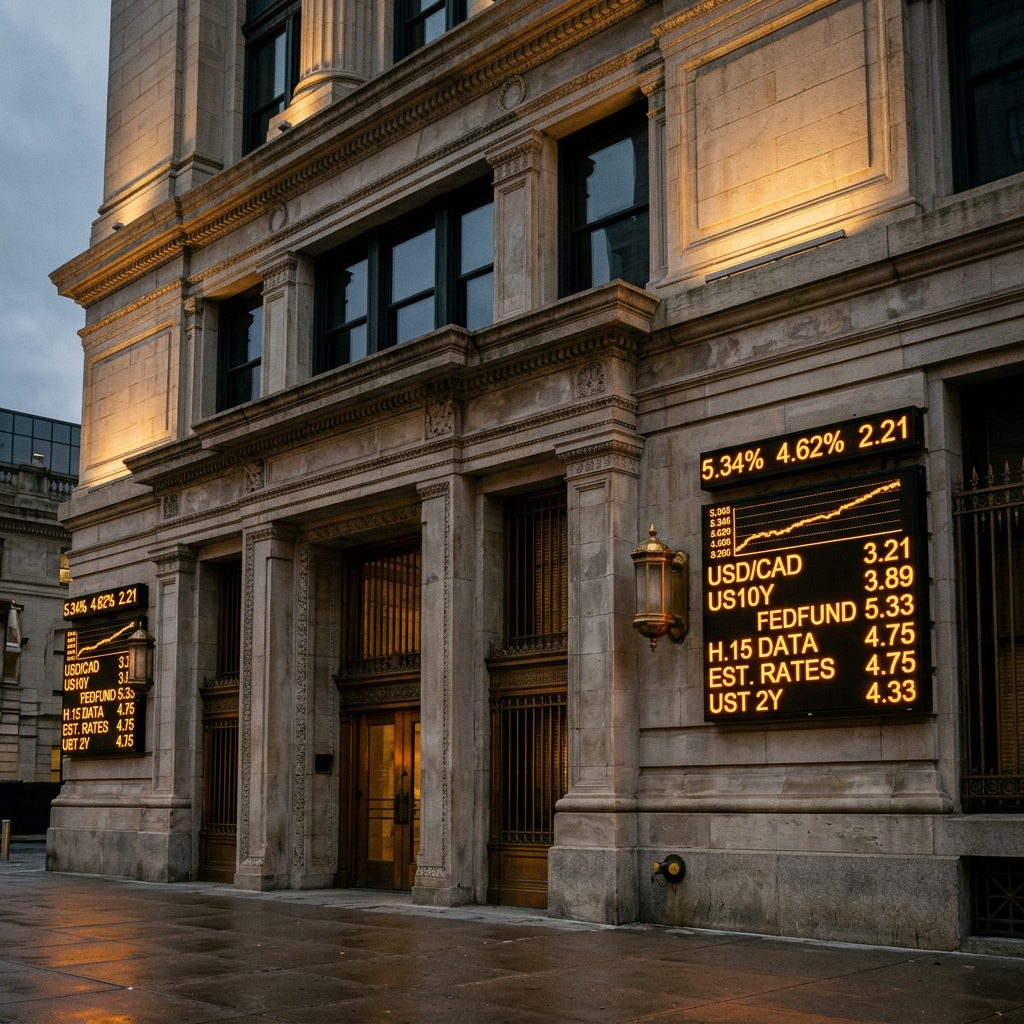
1. Fed's H.15 Release Gets a CASRAI Guide as SOFR and Treasury Yields Anchor Contracts
The Federal Reserve's H.15 release is one of the most read and least understood documents in North American finance. Published each business day by the Board of Governors, it lists the effective federal funds rate, SOFR, Treasury constant maturities, the bank prime loan rate, corporate bond yields and mortgage rates. CASRAI's new guide treats the release as a data standard, not a policy signal. That distinction matters for treasurers who must map a contract clause to a published series and for auditors who need a defensible source for the rate on a given date.
The H.15 is not a single formula. Each series has its own source and convention. The effective federal funds rate is a volume-weighted median of overnight transactions reported through the Federal Reserve Bank of New York. SOFR is a secured overnight financing rate built from repo transactions. Treasury constant maturity yields come from the Treasury yield curve. The prime rate is the rate posted by a majority of top 25 insured U.S.-chartered commercial banks. CASRAI's note puts those definitions beside the footnotes that often decide a contract dispute.
The guide also separates the H.15 from discontinued benchmarks. The Fed stopped publishing LIBOR-based series after June 2023, and legacy contracts now point to SOFR or to fallback language. A borrower that still keys a loan to a stale H.15 line can misprice interest by tens of basis points. On a US$50 million facility, 25 basis points is US$125,000 a year. That is the kind of number that reaches a board risk committee before it reaches a courtroom.
2. Canadian Banks and Treasurers Recalibrate US Dollar Exposure Against the Daily H.15 Tape
Canadian financial institutions use the H.15 as an input, not as a final authority. The Bank of Canada sets the policy rate and publishes CORRA, the Canadian overnight repo benchmark. A Toronto bank lending in U.S. dollars may price a facility at SOFR plus 150 basis points, then hedge the currency exposure. The H.15 supplies the SOFR and Treasury legs that make the loan and the hedge traceable for auditors. A 25 basis point move in SOFR on a US$250 million book changes annual interest by US$625,000 before hedging.
The cross-border tax chain runs through the same data. CRA and the IRS expect related-party loans to carry arm's length interest. A Canadian subsidiary borrowing from a U.S. parent may cite H.15 Treasury yields or SOFR as the base, then add a credit spread supported by comparables. CRA's prescribed rates govern some domestic tax balances, but they do not settle a U.S. dollar related-party loan. Tax teams that use the wrong H.15 series or the wrong date can face adjustments, penalties and double-tax risk under the Canada-U.S. treaty.
Accounting teams also consume the H.15 for fair value and disclosure. A private Canadian manufacturer with a US$100 million term loan may not trade bonds, but its auditor can test the discount rate against Treasury constant maturities and corporate indices. The H.15's daily frequency matters at quarter end and year end. A rate published on Dec. 31 can differ from the rate on the last trading day. CASRAI's guide flags that calendar detail because a one-day mismatch can move a material accrual.
3. Customs, Duty Deferrals and Freight Corridors Feel the Rate Signal
The H.15 reaches the physical border through working capital. An importer moving auto parts across the Ambassador Bridge pays duties, brokers and carriers before the finished vehicle is sold. CBP and CBSA clearance rules allow duty deferral and bonded movement, but the financing behind those programs carries a cost. When SOFR rises 50 basis points, a US$20 million revolving line for customs and freight costs an extra US$100,000 a year. That cost lands on the same spreadsheet as trucking rates and warehouse charges.
The freight corridors make the exposure concrete. The Ambassador Bridge carries about US$400 million in daily two-way trade between Windsor and Detroit. The Blue Water Bridge at Sarnia-Port Huron moves chemicals, agriculture and auto parts. The Pacific Gateway handles Asian containers that clear under USMCA or most-favored-nation rules. CPKC's rail network links Canadian grain and energy shippers to U.S. Gulf and Midwest markets. Each route depends on credit lines priced off short-term U.S. rates. The H.15 is the public tape for those lines.
USMCA dispute panels do not set interest rates, but they shape the rules that determine whether a shipment qualifies for preferential duty. A producer that cannot document regional value content may pay duty and finance that cash cost. The H.15's Treasury and SOFR series then feed the importer's cost of carry. CBP and CBSA auditors can demand records that tie a claimed rate to a published source. A CASRAI-style data guide is useful evidence when the dispute turns on the rate date, the tenor or the compounding method.
4. Fed-Bank of Canada Divergence Tests Hedges, Contracts and 2026 USMCA Review
The strategic question is not whether the H.15 is accurate. The question is which series governs a contract when the Fed and the Bank of Canada move apart. If the Fed holds its target range while the Bank of Canada cuts by 25 basis points, the CAD can weaken and Canadian exporters gain price room in U.S. markets. A Canadian borrower with U.S. dollar debt sees the opposite effect. The H.15's Treasury and SOFR lines become the neutral reference that both sides can audit. Contract language that names the wrong line creates a basis risk that no hedge removes.
For executives, the H.15 guide is a governance tool. Treasury policy should name the exact H.15 series, the publication date, the day-count convention and the fallback if the Fed changes the release. A US$500 million cross-border credit facility can carry US$2.5 million in annual interest for every 50 basis points. The board should see that sensitivity beside the FX hedge ratio. The same discipline applies to intercompany loans reviewed by CRA and the IRS. A rate memo that cites the H.15 by series and date is stronger than a generic benchmark reference.
The 2026 USMCA joint review adds a policy deadline. Investors will watch whether Washington and Ottawa tighten rules of origin, customs data or dispute timelines. The H.15 will not appear in the treaty text. It will appear in the financing models that decide where firms place plants, inventory and rail capacity. A Canadian auto supplier weighing an expansion near the Blue Water Bridge or a CPKC intermodal terminal needs a U.S. dollar rate forecast. The Fed's daily release is the common language for that forecast. CASRAI's guide makes the language harder to misread.