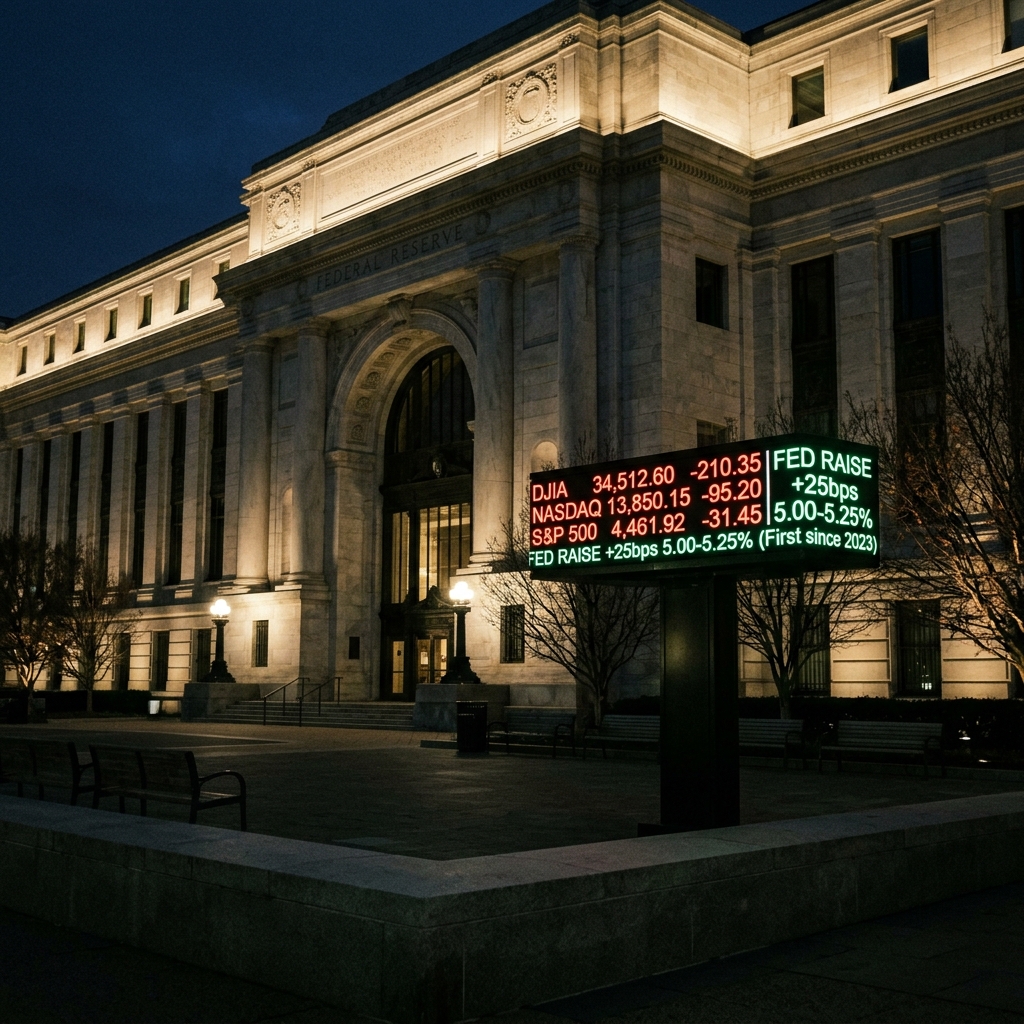
1. Powell Breaks the Pause With a Hawkish 25-Basis-Point Move
The Federal Open Market Committee broke more than a year of monetary stasis, voting to lift the benchmark federal funds rate by 25 basis points to a target range of 5.50 to 5.75 percent. ABC News reported the move, which caught short-term interest rate traders off guard after markets had priced in steady rates through the middle quarters. Federal Reserve Chairman Jerome Powell pointed directly to sticky services inflation and strong consumer balance sheets as the main drivers behind the hike. It marks Washington's first upward rate adjustment since July 2023.
The vote was divided. Two regional Fed bank presidents dissented, arguing that the committee should hold the line while earlier quantitative tightening continued to work through the financial system. Even so, resilient hiring and upward revisions to gross domestic product pushed the majority to act. Core personal consumption expenditures had held stubbornly above an annualized 2.8 percent over the previous two quarters. In his post-meeting press conference, Powell made it clear that policy will stay restrictive until inflation drops convincingly to the statutory 2.0 percent goal.
North American money markets reacted within seconds. Short-term US Treasury yields spiked. The two-year note yield jumped 14 basis points to 4.88 percent inside thirty minutes. Swap contracts tied to the secured overnight financing rate adjusted instantly, erasing earlier bets on rate cuts for the coming year. Commercial lenders in New York and Chicago lifted their prime lending rates to 8.75 percent before the close, immediately raising borrowing costs on variable-rate commercial credit lines.
2. Bank of Canada Trapped Between Stalled Growth and Currency Depreciation
The Fed's move leaves Bank of Canada Governor Tiff Macklem facing a difficult dilemma in Ottawa. Canadian growth is sluggish. Indebted retail borrowers are pulling back, and per-capita household spending continues to drag. The Bank of Canada had already started cutting rates to steady consumer confidence and provide relief for homeowners facing five-year fixed and variable mortgage renewals. Washington's sudden hike upends hopes for a synchronized North American easing cycle and puts fresh pressure on the exchange rate.
The widening interest rate gap between Washington and Ottawa is already driving capital flows. Global asset allocators are moving cash into higher-yielding US sovereign paper, sapping demand for Government of Canada bonds. The Canadian dollar fell 0.6 percent against the greenback, trading near 71.40 cents US. That drop carries practical costs. A weaker loonie pushes up the price of machinery, industrial parts, and food arriving from the United States, importing inflation straight across border crossings like the Ambassador Bridge and the Blue Water Bridge.
Macklem now faces a hard trade-off. If the Bank of Canada cuts rates further to cushion mortgage holders, the loonie could slide toward historic lows near 70 cents US. If it holds or raises rates to defend the dollar, heavily indebted households face rising default risks. Canadian policymakers simply cannot break away from the Federal Reserve's trajectory without triggering significant domestic fallout.
3. Cross-Border Freight, Trade Financing, and Supply Chain Pressures
The rate hike hit trade networks governed by the United States-Mexico-Canada Agreement almost immediately. Auto parts suppliers across Southern Ontario and Michigan lean heavily on floating asset-backed loans for day-to-day cash flow. With the US prime rate moving higher, effective borrowing costs on open accounts receivable climbed for manufacturers moving goods through Detroit and Windsor. Canadian suppliers that bill their tier-one partners in local currency face an uncomfortable squeeze, particularly when buying raw materials priced in greenbacks.
Cross-border trucking firms face their own balance sheet strain. Motor carriers hauling loads on Interstate 75 and Ontario Highway 401 run on narrow margins. Higher interest charges on new diesel rigs and warehouse facilities arrive at an unwelcome time. Rail operators Canadian Pacific Kansas City and Canadian National Railway face increased debt costs on upcoming capital programs, prompting finance teams to re-evaluate payback timelines for network expansion projects.
Clearance through US Customs and Border Protection and the Canada Border Services Agency remains orderly, but the paperwork behind that trade is shifting. Treasurers want faster settlement times to curb currency risk. In Quebec and Alberta, industrial machinery importers are using structured forward contracts with chartered banks to hedge against price swings. Across the board, logistics teams are working with leaner inventory levels to hold down carrying costs.
4. Debt Capital Markets Face Realignment as the Rate Spread Expands
Corporate bond desks in Calgary and Toronto saw several offerings pause after the Fed announcement. Canadian corporations frequently look south, using the US private placement and Yankee bond markets for large institutional debt sales. As US benchmark yields stepped up, cross-currency basis swaps moved erratically. Energy producers in Alberta must now pay higher premiums to swap US-dollar debt obligations back into Canadian dollars for balance-sheet reporting.
US institutional funds are shifting their sovereign exposure as well. Stronger returns on standard US Treasury bills make Canadian provincial debt, including bonds from Ontario and Quebec, less attractive by comparison. Both provinces count on international buyers to absorb massive annual borrowing programs. To keep global investors at the table, provincial treasuries will have to pay wider spreads over Treasuries, adding real costs to public balance sheets over the coming years.
The near-term outlook for bilateral capital spending looks more conservative. Corporate investment plans financed by syndicated credit facilities face tougher internal scrutiny through year-end. Canadian resource exporters benefit from lower operational costs at home thanks to the weaker dollar, but their US-dollar capital equipment purchases will cost more. Companies on both sides of the border are now planning for interest rates to stay higher for considerably longer than earlier forecasts suggested.