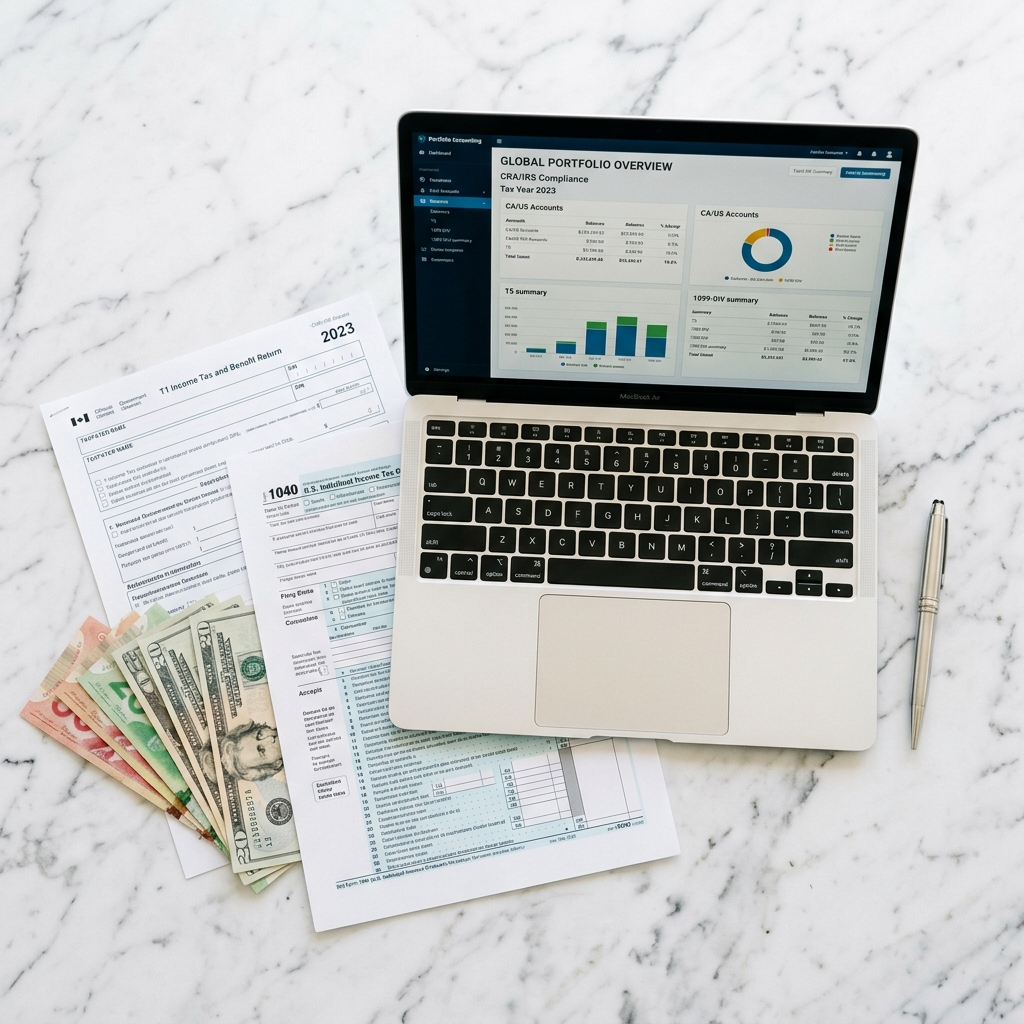
As Canadian retail and institutional capital continues to flow heavily into US equities, tech startups, and Sunbelt real estate, Canada Revenue Agency (CRA) enforcement of Form T1135 (Foreign Income Verification Statement) has reached unprecedented scrutiny in 2026.
Any Canadian tax resident (individual, corporation, or trust) holding 'Specified Foreign Property' with an aggregate cost base exceeding $100,000 CAD at any point during the tax year is legally mandated to file Form T1135 alongside their annual T1/T2 income tax return.
Critical confusion frequently arises regarding what constitutes Specified Foreign Property. US-listed equities (such as Apple, Microsoft, or Nvidia) held within a non-registered Canadian brokerage account are fully reportable. However, US securities held inside registered tax-sheltered accounts (RRSPs, TFSAs, RRIFs, or FHSAs) are explicitly exempt from T1135 filing obligations.
Furthermore, tangible real estate situated in the United States is categorized based on intent of use. A Florida vacation condominium maintained exclusively for personal recreation is exempt under the personal-use property rule. However, if the property is listed on rental platforms (such as Airbnb or long-term lease) for even a partial duration of the year, it converts into income-producing foreign property and must be declared.
Penalties for failure to file Form T1135 are severe: statutory fines accumulate at $25 per day up to a maximum of $2,500 per tax year for inadvertent omissions, escalating to $500 to $1,000 per month for gross negligence. Taxpayers discovering past non-compliance should immediately seek relief through the CRA Voluntary Disclosures Program (VDP).