1. Trade Veterans Condemn Proposed Duties as Direct Breach of Treaty Law
A growing coalition of former United States trade officials has broken cover to publicly challenge Donald Trump's proposed 25 percent tariff on Canadian imports, as reported by Newsweek. The veterans, who served across both Republican and Democratic administrations, argue that imposing universal duties under the International Emergency Economic Powers Act (IEEPA) abuses statutory authority. They maintain that treating Canada as a national security risk or an illicit border conduit ignores the explicit terms of the United States-Mexico-Canada Agreement (USMCA). That pact entered into force in July 2020 to guarantee preferential, tariff-free market access for compliant regional production.
The former negotiators point out that the USMCA contains formal dispute-settlement mechanisms under Chapter 31 designed specifically to adjudicate cross-border grievances. Bypassing these established legal channels to execute unilateral economic penalties threatens to unravel trade stability across the continent. Legal specialists note that unilateral tariffs would trigger immediate petitions before binational panels and the United States Court of International Trade. The move exposes Washington to systematic retaliation against high-value American agricultural and industrial exports. Those retaliatory measures would land directly in politically sensitive agricultural and manufacturing states before the scheduled 2026 joint review of the trade agreement.
The public intervention by these policy architects exposes deep divisions within Washington's conservative trade establishment. While populist hardliners advocate aggressive tariff use to extract non-trade concessions on border security and drug interdiction, career negotiators view the weaponization of commercial pacts against a core ally as dangerous. Canada is the top export destination for thirty-six United States states. Former officials caution that treating a treaty partner like a strategic rival creates global commercial uncertainty and weakens the standing of the United States as a dependable counterparty in complex bilateral pacts.
2. Great Lakes Manufacturing Network Braces for Severe Tariff Drag
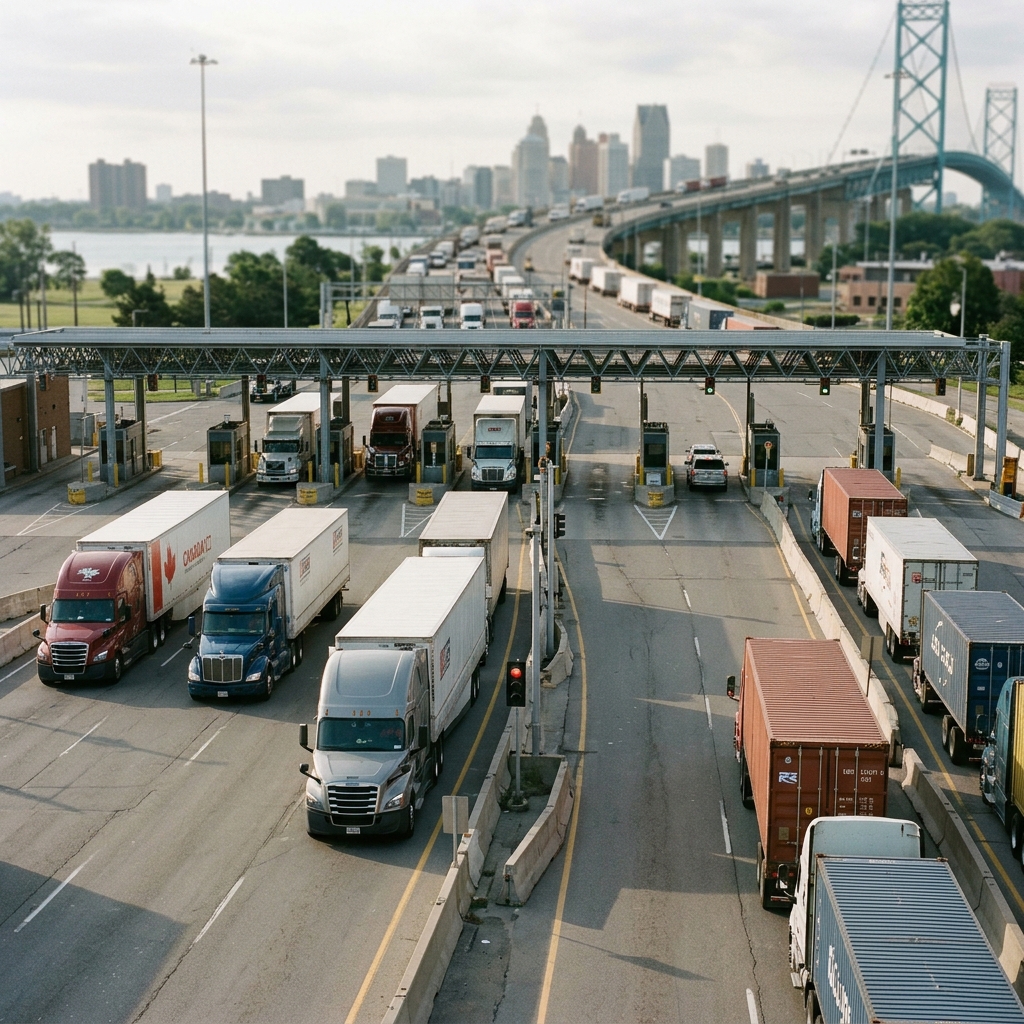
The primary flashpoint for the proposed tariffs is the heavily integrated manufacturing corridor linking southern Ontario to the United States industrial Midwest. Every single day, approximately 1.4 billion dollars in bilateral merchandise trade moves across the northern border. Commercial truck arteries like the Ambassador Bridge connecting Windsor to Detroit and the Blue Water Bridge linking Point Edward to Port Huron carry the weight of this exchange. The cross-border automotive sector operates without substantial domestic inventory buffers, relying entirely on synchronized, just-in-time delivery schedules maintained by carriers on both sides.
Automotive components, intermediate stampings, and sub-assemblies routinely cross the international boundary up to eight times before rolling off assembly lines in Michigan, Ohio, or Ontario as completed vehicles. Major Tier-1 automotive suppliers, including Magna International, Linamar, and American Axle, maintain production facilities configured on the presumption of zero-tariff border crossings. Imposing a 25 percent levy at every border check managed by U.S. Customs and Border Protection (CBP) would cause cascading cost increases throughout the production chain, rendering several vehicle lines unprofitable within weeks of implementation.
Industry trade associations calculate that a 25 percent tariff across the Detroit River and Niagara frontiers would inflate the average price of a North American-built vehicle by roughly 3,000 dollars. Neither United States assembly plants nor Canadian parts suppliers can absorb margins of that magnitude without idling lines or cutting capital expenditure programs. The resulting disruption would force original equipment manufacturers to choose between halting assembly operations or absorbing steep balance-sheet losses, which would prompt corporate layoffs across both Michigan and Ontario auto hubs.
3. Midwest Refineries Face Crude Shortages Under Blanket Import Penalties
Beyond automotive manufacturing, former energy policy officials warn that an aggressive tariff schedule would destabilize the refining complex across the American Midwest. United States Petroleum Administration for Defense District 2 (PADD 2) relies fundamentally on Canadian heavy crude. Canada exports more than 4 million barrels per day of crude oil to its southern neighbor, mostly via Enbridge's extensive Mainline pipeline network and Express pipelines. These specialized pipelines feed massive refineries across Illinois, Minnesota, and Indiana that operate configurations specifically designed to refine heavy Western Canadian Select (WCS).
Midwest refiners cannot substitute Canadian heavy crude with light, sweet crude produced in Texas's Permian Basin without undertaking expensive and time-consuming refinery modifications. If Canadian pipeline volumes incur a 25 percent import tax at physical border intake valves, those tariffs will translate into higher feedstock costs for regional refineries. Gulf Coast waterborne alternatives from Latin America or the Middle East would take months to procure and transport. The resulting operational squeeze would cause higher rack prices for diesel, gasoline, and jet fuel across central United States retail distribution points.
The Canada Border Services Agency (CBSA) and provincial capitals like Alberta are already examining structural responses. Provincial premiers have warned that Ottawa could consider reciprocal export surcharges or prioritize alternative outbound logistics, such as the newly expanded Trans Mountain pipeline corridor. That route moves crude directly from Alberta to the Pacific coast for delivery to Asian buyers. Redirecting Canadian energy away from United States refiners would leave American industrial processors scrambling for crude while facing surging production costs for refined petroleum products.
4. Central Bank Dilemma and the Threat of Asymmetric Currency Shocks
The prospect of universal cross-border duties introduces significant friction into macroeconomic planning for both the Bank of Canada and the Federal Reserve. Macroeconomic models constructed by Bay Street and Wall Street trading desks suggest that a full-scale 25 percent tariff would cut Canadian gross domestic product by 2.0 to 2.5 percent in the first full year of implementation. Faced with a severe demand contraction in Canada's largest export destination, Bank of Canada Governor Tiff Macklem would confront acute pressure to slash interest rates to backstop domestic employment and liquidity.
In Washington, Federal Reserve Chairman Jerome Powell faces the opposite problem. A 25 percent tariff applied across Canadian energy, softwood lumber, plastics, and aluminum imports would add an estimated 60 to 80 basis points to United States core Personal Consumption Expenditures (PCE) inflation. Higher import prices on base commodities would sustain price pressures across domestic construction and industrial sectors. This dynamic would limit the Federal Reserve's capacity to continue easing its policy rate, forcing United States benchmark yields to remain higher for a longer period.
This divergence in monetary policies would accelerate the devaluation of the Canadian dollar, driving the currency below 70 cents against the United States dollar. While a weaker Canadian dollar theoretically makes Canadian exports cheaper abroad, it dramatically increases the cost of imported United States industrial machinery, commercial aircraft, and consumer goods. The net result across the integrated CPKC and CN rail corridors would be lower intermodal freight volumes, elevated cross-border financing costs, and a sharp cooling in corporate capital expenditures throughout North America.