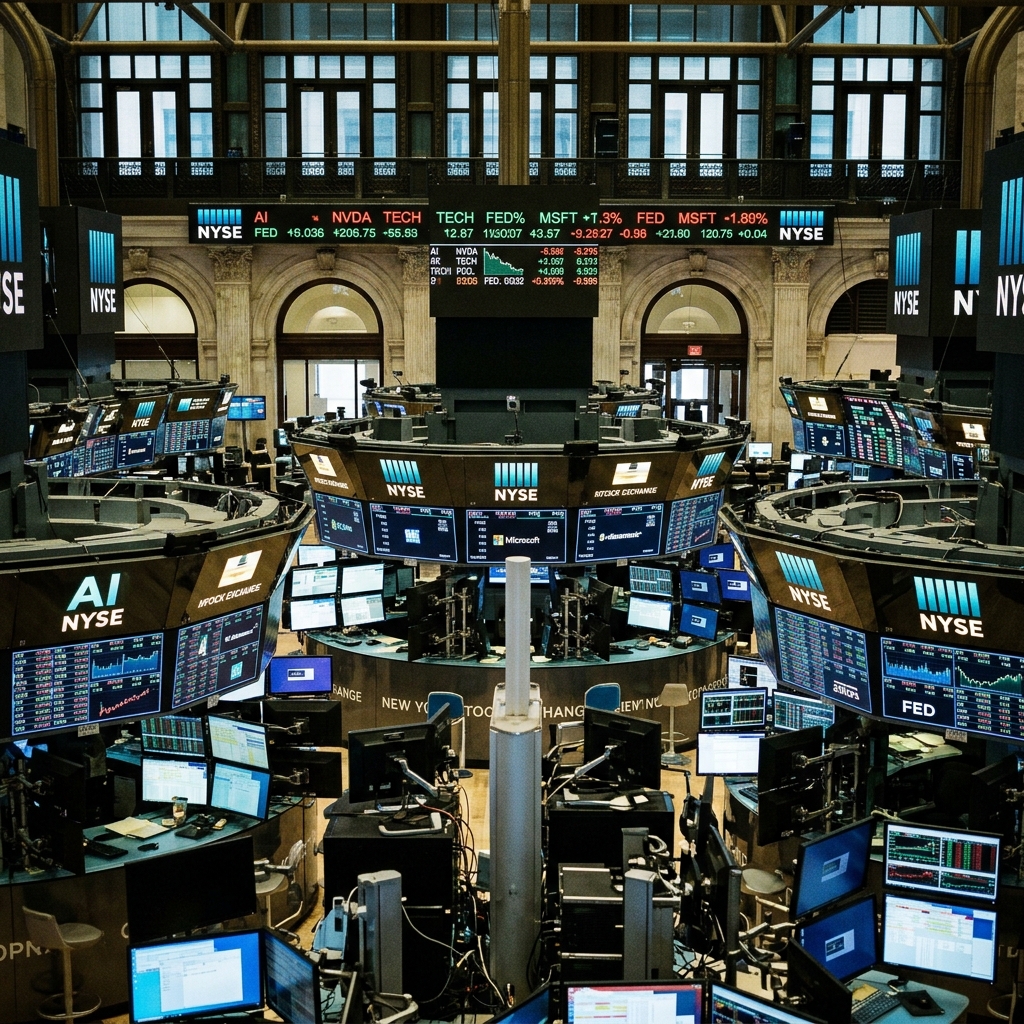
1. Goolsbee Puts AI Capital Spending at Center of Fed's Inflation Watch
Chicago Federal Reserve President Austan Goolsbee told Reuters the Fed's immediate job is to keep the artificial-intelligence investment wave from overheating the U.S. economy. That comment puts a label on a policy problem that reaches factories, utilities and freight yards. AI spending is a capital-expenditure cycle. It creates measurable demand for electricity, transformers, construction crews, cooling systems and advanced chips. Goolsbee's framing matters because the Fed sets the federal funds target range. That rate anchors borrowing costs from Toronto to Detroit.
The chain is easy to trace. Data-center construction pulls on local labor and materials. Grid operators face new load requests. Utilities buy more transformers and gas turbines. Semiconductor imports rise through Pacific Gateway ports and air cargo hubs. Each link can add to prices before new supply arrives. The Fed cannot set chip policy or approve transmission lines. It can set the cost of capital. A 25 basis point change in the funds rate moves the discount rate on multiyear projects. Goolsbee's warning is therefore a signal to investors who underwrite AI capacity on cheap money.
Goolsbee's argument does not treat AI as a bubble to pop. It treats AI as a demand shock to manage. If productivity gains arrive quickly, the economy can absorb more investment without inflation. If gains lag, the same spending can bid up wages and electricity. The Fed's dual mandate of stable prices and maximum employment forces a judgment call. The Bank of Canada faces a related call. Canadian utilities and manufacturers sell into the same North American AI supply chain. Reuters reported Goolsbee's view as a policy priority, not a forecast.
2. Utilities, Chip Supply and the 25-Basis-Point Transmission Channel
The first place AI demand shows up is electricity. PJM Interconnection's capacity auctions and ERCOT's load forecasts now include large data-center requests. Utilities in Ontario, Quebec and British Columbia see the same signal from U.S. customers. Hydro-Québec exports power into New York and New England. Ontario's Independent Electricity System Operator manages a grid tied into Michigan and New York. A surge in U.S. data-center load can lift cross-border power prices and pull Canadian generation into export markets. The Fed watches these prices. Electricity is an input cost for every business.
Tax policy runs alongside monetary policy. The U.S. CHIPS and Science Act uses IRS credits to support advanced manufacturing. Canada's Clean Technology Investment Tax Credit is administered by the Canada Revenue Agency. Those subsidies lower the after-tax cost of data centers, battery plants and chip fabs. The Fed cannot offset a fiscal subsidy with one rate move. It can tighten financial conditions enough to make marginal projects wait. Investors compare a project's internal rate of return with the 10-year Treasury yield. A 50 basis point rise in that yield can kill a marginal data-center plan.
Equipment supply is the second channel. Large power transformers have lead times measured in years. Switchgear, cooling systems and high-bandwidth networking gear are scarce. Nvidia's AI accelerators move through Pacific Gateway ports and air freight terminals. CPKC rail networks carry components and construction materials across the continent. When demand outruns supply, prices rise. The Fed's inflation models track goods prices and business investment. Goolsbee's point is that AI capex can look like strength in GDP while adding to the price index the Fed is trying to bring back to 2 percent.
3. USMCA, CBP and CBSA Clearance for AI Hardware
The cross-border link is both physical and legal. AI servers, power modules and precision cooling units cross at Ambassador Bridge and Blue Water Bridge, then move by CPKC rail and truck to data-center sites in Ohio, Virginia and Texas. CBP and CBSA officers classify the goods, collect duties and check USMCA rules of origin. A misclassified power component can stall at the border. A tariff change can alter project costs by millions of dollars. The Fed's rate signal affects the financing. Customs rules affect the landed cost.
USMCA dispute panels matter for the supply chain. Canada and the United States have fought over automotive rules of origin, dairy quotas and digital services taxes. AI hardware adds new pressure points. Export controls on advanced chips are a U.S. national-security tool, not a USMCA provision. Canadian firms that integrate U.S. chips into servers must track license conditions. CRA and IRS auditors also examine transfer pricing for intellectual property. A data-center operator that shifts software rights between Toronto and Austin can face tax adjustments on both sides of the border.
Freight corridors set the pace. The Pacific Gateway handles containerized chips and networking gear from Asia. CPKC and Canadian National rail lines move freight to Chicago and Kansas City. The Ambassador Bridge carries roughly a quarter of U.S.-Canada truck trade. Blue Water Bridge adds capacity at Sarnia-Port Huron. A bottleneck at any point raises the effective cost of AI investment. The Fed reads those costs through producer prices and import prices. Goolsbee's warning is a reminder that monetary policy works through real supply chains and bond markets.
4. Bank of Canada, Fed Divergence and the AI Capex Cycle
The Bank of Canada has its own inflation target and its own policy rate. It cannot simply copy the Fed. Canada's economy is more sensitive to housing and commodities. A U.S. AI capex boom raises demand for Canadian electricity, copper, aluminum and engineered wood. It also pulls Canadian workers into higher-paying U.S. projects. That can tighten Canadian labor markets. If the Bank of Canada cuts rates by 25 basis points while the Fed holds, the loonie can weaken. A weaker loonie raises import prices for U.S. goods and complicates the inflation fight on both sides.
For executives, the practical test is project timing. A data-center sponsor should stress-test cash flows against a 50 basis point rise in the 10-year Treasury yield and a 10 percent rise in electricity costs. It should map customs classification for every imported power component. It should confirm CRA and IRS treatment of tax credits before construction. Pension funds such as CPP Investments and utility holding companies in Ontario and Quebec are already allocating capital to data centers. The Fed's stance changes the hurdle rate for those allocations.
The result is a tighter link between monetary policy and industrial policy. The Fed can slow demand with higher rates. It cannot build transformers, approve interconnections or clear cargo at the Ambassador Bridge. The Bank of Canada can adjust rates for Canadian conditions. It cannot control U.S. data-center demand. Goolsbee's comment puts the AI surge inside the Fed's policy calculus. Every capacity auction, chip shipment and border clearance now carries a monetary-policy signal for investors in New York, Toronto and Montreal.