1. Alliston Plant Modernization Secures Ontario Industrial Foothold
Honda Motor has approved an 867 million Canadian dollar capital deployment for its Alliston, Ontario manufacturing operations. The investment upgrades tooling, robotic welding infrastructure, and battery-pack installation cells across Plant 1 and Plant 2. Automotive News first reported the program, which locks in factory capacity for the next run of hybrid-electric models. Retrofits will take place during scheduled changeovers, protecting jobs for roughly 4,200 direct technical and assembly staff.
Both the Ontario provincial government and the federal Ministry of Innovation, Science and Economic Development assembled joint financial packages to back the retooling. These incentives align with capital allowances under Canada's Clean Technology Manufacturing investment tax credits. Assembly plants in Ontario deal with higher power rates and freight bills than their rivals in the American South. The Alliston commitment shows Honda still values Southern Ontario's skilled engineering base, provided state subsidies cushion the front-end depreciation on heavy machinery.
Alliston builds the CR-V compact crossover and Civic sedan. Both are core revenue drivers for American dealers. About 60 percent of finished vehicles rolling out of Alliston head straight across the border into the United States. Supply routes feeding the facility depend on stamping lines in Ohio and transmission plants in Georgia. Any border tie-up in Ontario quickly starves commercial lots from Detroit to Kansas City.
2. Tariffs and Tightened Origin Rules Weigh on Assembly Economics
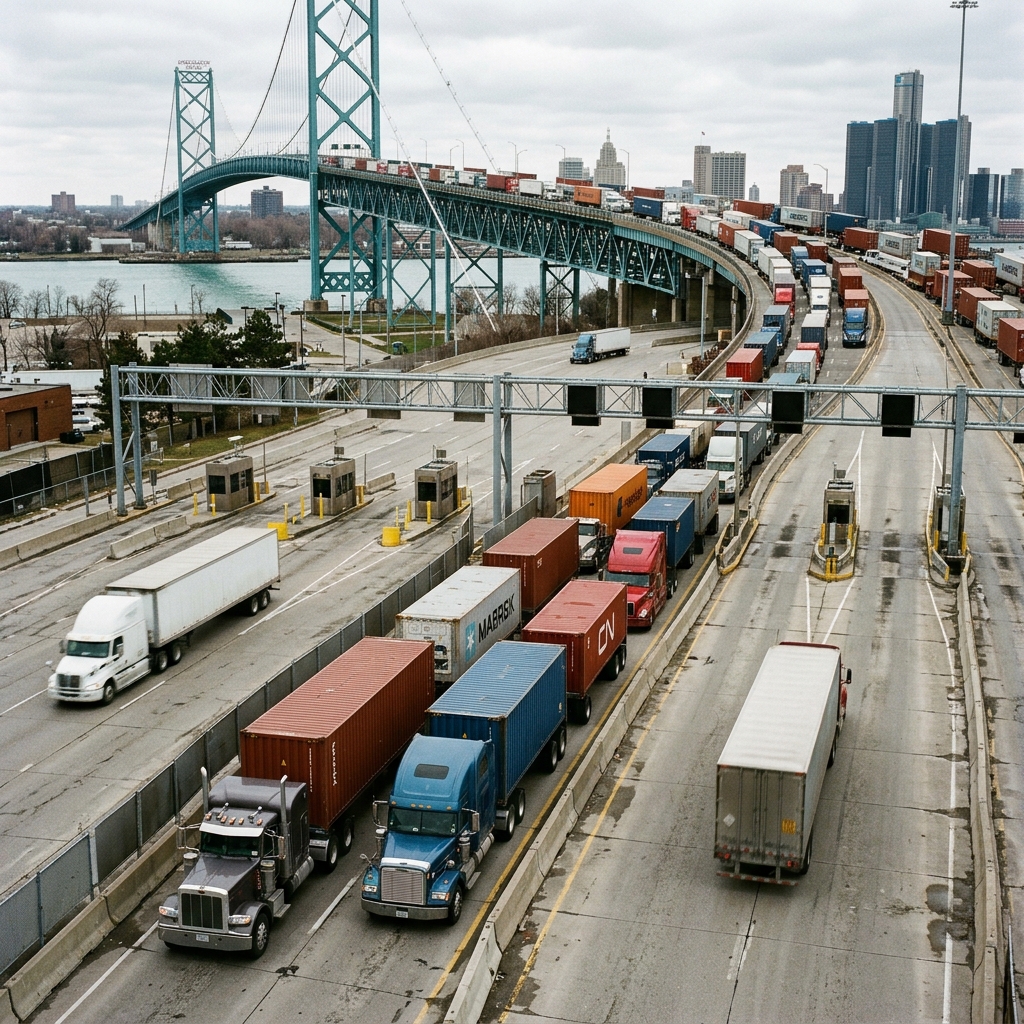
Honda is making this multi-year commitment despite clear trade friction. Rhetoric from Washington and targeted enforcement actions continue to squeeze cross-border automotive logistics. U.S. Customs and Border Protection officers now scrutinize bills of lading and origin certificates far more aggressively at the Ambassador Bridge and the Blue Water Bridge. Under the United States-Mexico-Canada Agreement, automakers must prove that at least 75 percent of vehicle content is regional to skip the standard 2.5 percent duty on passenger cars.
Trade compliance grows complicated when sub-tier suppliers buy minerals and microchips outside North America. The United States Trade Representative has repeatedly warned against routing overseas parts through third countries. Tier-1 suppliers shipping components to Alliston from Michigan and Ohio must trace tier-3 casting alloys back to certified smelters. This audit trail adds millions of dollars in annual paperwork and operational overhead for every platform running on the floor.
Arguments over core parts math still drag on among Washington, Ottawa, and Mexico City. A formal USMCA dispute panel rejected strict American readings of roll-up rules for regional value content, yet United States trade officials keep leaning toward protectionist domestic sourcing. Honda has to balance these shifting rules with continuous parts deliveries over CPKC and CN rail lines. In the end, executives in Tokyo chose local reinvestment over moving lines to the American Sun Belt, calculating that tariff compliance costs less than building a greenfield factory from scratch.
3. Supply Chain Mechanics Across the Detroit-Windsor Border Corridor
The border automotive corridor operates like an extended assembly line. Parts routinely crisscross the border eight times before final installation. Castings poured in Quebec travel to engine facilities in Anna, Ohio for precision machining, then ride back across the Blue Water Bridge into Alliston. A single border delay can idle a downstream plant in six hours.
The Canada Border Services Agency and U.S. Customs and Border Protection rely on pre-clearance programs for commercial trucks, but regulatory demands keep expanding. Thousands of parts loads pass between Windsor and Detroit every day. Drivers must carry digital manifests proving electric motors, wire harnesses, and steel stampings contain no uncertified critical minerals. Simple clerical errors hold up trucks, quickly piling on detention fees and unplanned line overtime.
Honda depends on Canadian Pacific Kansas City and Canadian National rail lines to ship heavy assemblies between Midwestern hubs and Ontario tracks. These networks answer to the Canadian Transportation Agency and the US Surface Transportation Board. Tariff warnings add real friction to scheduled rail runs. Shifting freight classifications and customs audits introduce pricing swings into long-haul contracts, forcing procurement managers to revise landed part costs every quarter.
4. Bilateral Investment Realities Amid Continental Auto Competition
Honda's 867 million Canadian dollar project defends Canada's place in an evolving manufacturing corridor. Southern US states have captured substantial auto capital since the passage of the US Inflation Reduction Act, leaning on grant packages and lower non-union payrolls. Reinvesting in Alliston gives Honda vital production redundancy. The plant sits next door to major consumer markets in the US Northeast and Eastern Canada, complementing its core hubs in Ohio and Indiana.
The spending plan also lays groundwork for future battery-electric models. Honda has outlined broader plans to build an end-to-end electric vehicle supply chain in Ontario, including cathode processing and cell manufacturing. Modernizing Alliston is step one. If Washington raises duties on foreign-assembled cars later this decade, Honda will need strict regional compliance from these very plants to protect its margins.
Auto executives are watching Alliston closely. The project proves that veteran manufacturing plants can secure capital even during an era of defensive trade policy. With the 2026 USMCA review approaching, corporate boards must weigh trade exposure against geography and experienced workforces. Honda is placing a clear bet: integrated continental production still delivers solid returns despite the rise of protectionist trade barriers.