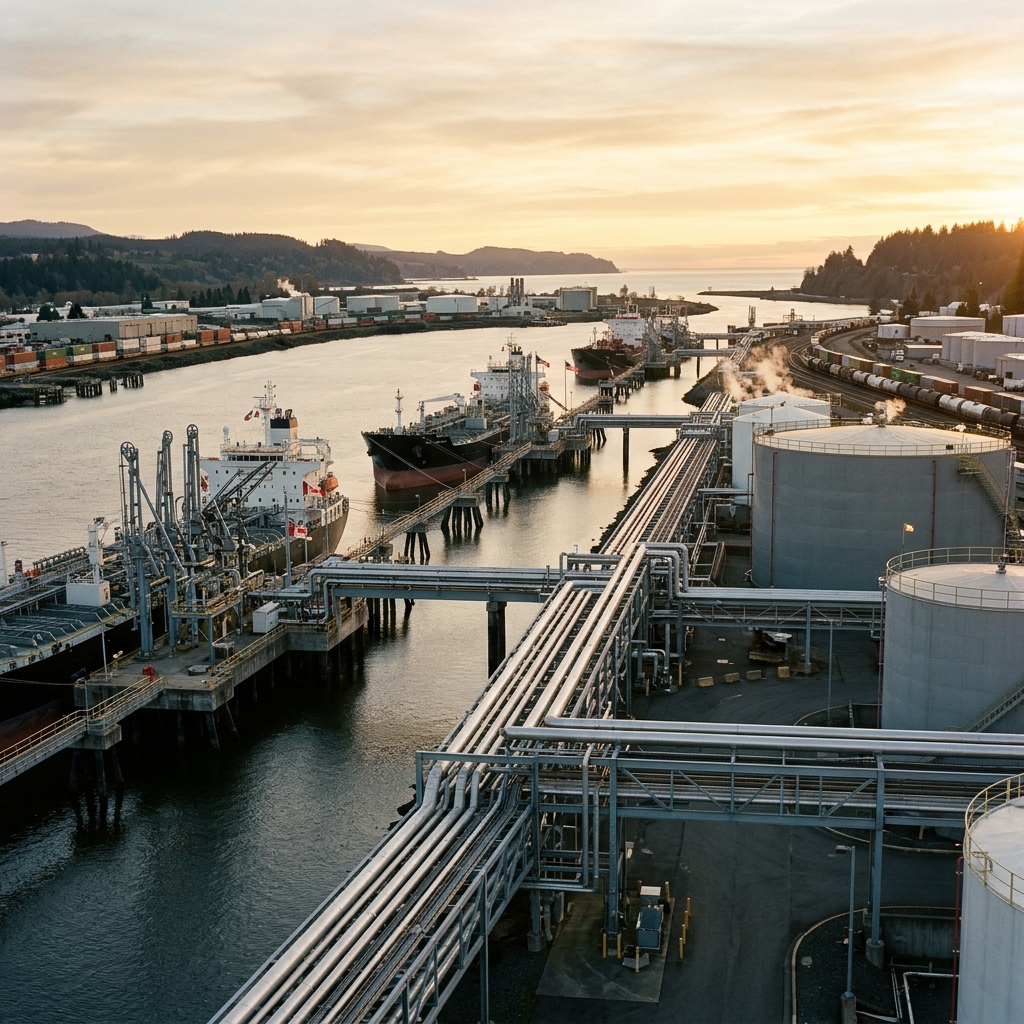
1. Bilateral Integration Collides With Federal Brinkmanship
Private capital allocations across the Pacific Northwest corridor have historically relied on regional micro-alignments that bypass Washington and Ottawa. Reporting from Maureen McCall in EnergyNow highlights how business executives gathered to advance cross-border logistics, hydro-power integration, and clean hydrocarbon supply chains only to see their planning upended by Donald Trump's protectionist rhetoric. The contrast could not be sharper. While commercial leaders from British Columbia, Alberta, Washington State, and Oregon construct joint decarbonization frameworks, national-level threats of sweeping import levies threaten to disrupt the primary trade conduits of the Cascadia corridor.
The economic footprint of this northwestern zone represents one of North America's most interdependent commercial ecosystems. Refineries in the Puget Sound basin depend directly on Canadian heavy and synthetic crude delivered via the Trans Mountain system and Puget Sound Pipeline spur. Simultaneously, British Columbia Hydro and the Bonneville Power Administration exchange balancing power across the border to maintain grid reliability under the Columbia River Treaty framework. Threatening these conduits with blunt tariff mechanisms introduces regulatory unpredictability into capital-intensive projects designed around multi-decade amortization schedules.
Corporate executives in attendance noted that sub-national economic cooperation cannot operate in a legal vacuum. Even when state governors and provincial premiers reach consensus on maritime trade lanes, hydrogen hub developments, or agricultural supply routes, federal executive powers over customs enforcement and national security trade designations retain absolute veto capability. McCall's analysis illustrates that the return of volatile trade mercantilism dismantles the baseline assumptions corporate treasurers require when underwriting cross-border infrastructure bonds or long-term take-or-pay commodity transport agreements.
2. Hydrocarbon Flows and Refinery Vulnerabilities in Puget Sound
Energy infrastructure along the 49th parallel operates under finely tuned operational balance. Five major refineries in Washington State, including facilities operated by BP at Cherry Point and Phillips 66 at Ferndale, process hundreds of thousands of barrels per day of Western Canadian crude. Imposing broad import tariffs on Canadian raw materials artificially inflates feedstock costs for American refiners while depressing netbacks for upstream producers in Alberta. McCall documents how private-sector delegates expressed dismay that technical work on pipeline efficiency and marine terminal coordination is being undercut by populist political positioning.
The timing of this political friction is particularly disruptive given recent capital outlays. The operational start of the Trans Mountain Expansion provided Canadian producers with alternative tidewater access via Westridge Marine Terminal in Burnaby, theoretically diversifying Canadian export optionality away from total reliance on the United States. However, the Pacific Northwest remains the most logistically coherent and margin-efficient destination for Canadian pipeline barrels. Introducing arbitrary border frictions forces energy majors to reconsider route optimization, potentially redirecting volumes entirely to Asian spot buyers at the expense of regional American industrial processing facilities.
Beyond crude oil, natural gas interconnections managed by Enbridge through the Westcoast Pipeline system supply the heating and power generation needs of millions of consumers across Washington and Idaho. Utility operators calculate capital expenditure years in advance under oversight from the Washington Utilities and Transportation Commission and the British Columbia Utilities Commission. Imposing tariff penalties on these energy transfers creates direct, unhedged operational liabilities for utilities, destabilizing cross-border power purchase agreements and driving retail power rate increases across regional commercial rate bases.
3. Cascadia Infrastructure and Supply Chain Polarization
The diplomatic friction detailed by McCall extends into multi-modal transport and manufacturing supply chains across Cascadia. High-level regional discussions aimed at expanding the Cascadia Innovation Corridor have long prioritized fast rail, cross-border carbon capture networks, and coordinated port automation between the Port of Vancouver and the Northwest Seaport Alliance of Seattle and Tacoma. These capital programs require harmonized customs protocols and regulatory reciprocity. When federal executive authority signals hostility to trade partners, multi-jurisdictional municipal and corporate financing consortiums immediately pause funding commitments.
Advanced industrial manufacturing in the Pacific Northwest relies on just-in-time logistics spanning the border. Aerospace components, advanced forestry products, and specialized marine technology transit border points such as Blaine and Abbotsford multiple times during production cycles. Tariff escalation dismantles the economic rationale of these integrated value chains. Regional trade associations point out that small to mid-sized suppliers lack the balance sheet flexibility to absorb administrative tariff compliance costs, leading directly to production cutbacks and vendor rationalization that weakens the Pacific Northwest's competitive standing against foreign industrial zones.
The institutional apparatus designed to insulate this region from federal volatility is showing unprecedented strain. For decades, organizations such as the Pacific Northwest Economic Region (PNWER) provided a statutory forum for state and provincial legislators to solve cross-border frictions cooperatively. As McCall reports, private-sector delegates now question whether sub-national statutory bodies can withstand aggressive unilateral trade policies initiated by federal administrations willing to disregard the structural provisions of the United States-Mexico-Canada Agreement (CUSMA/USMCA).
4. Strategic Repercussions for Cross-Border Investment
Institutional asset allocators managing cross-border infrastructure funds are factoring a distinct sovereign risk premium into Canadian-American energy assets. McCall's reporting signals that corporate leaders no longer view trade disputes as minor cyclical adjustments, but rather as structural impediments to capital deployment. If integrated energy systems are treated as leverage points in broader geopolitical negotiations, private sponsors will demand higher internal rates of return before committing capital to cross-border pipeline expansions, interties, or clean technology pilot projects across the regional corridor.
Canadian business leaders are increasingly pressured to hedge against American political volatility by accelerating domestic market development and non-U.S. export pathways. This includes re-evaluating internal Canadian trade barriers and redoubling investments in Arctic or direct Pacific maritime shipping lanes that bypass American territory entirely. However, structural proximity makes complete decoupling impossible. The Western Canadian sedimentary basin and the Pacific Northwest industrial complex remain functionally codependent, meaning that political attempts to erect border barriers inevitably destroy equity value on both sides of the frontier.
The broader takeaway from McCall's dispatch is the growing fragility of regional economic governance in North America. When bilateral private-sector coordination is systematically undermined by erratic trade threats from national leadership, the certainty required for industrial modernization evaporates. Market participants must now construct operational resilience strategies that anticipate sudden regulatory shocks, legal challenges under trade dispute panels, and the chronic politicization of basic energy and commodity flows between historically secure international partners.