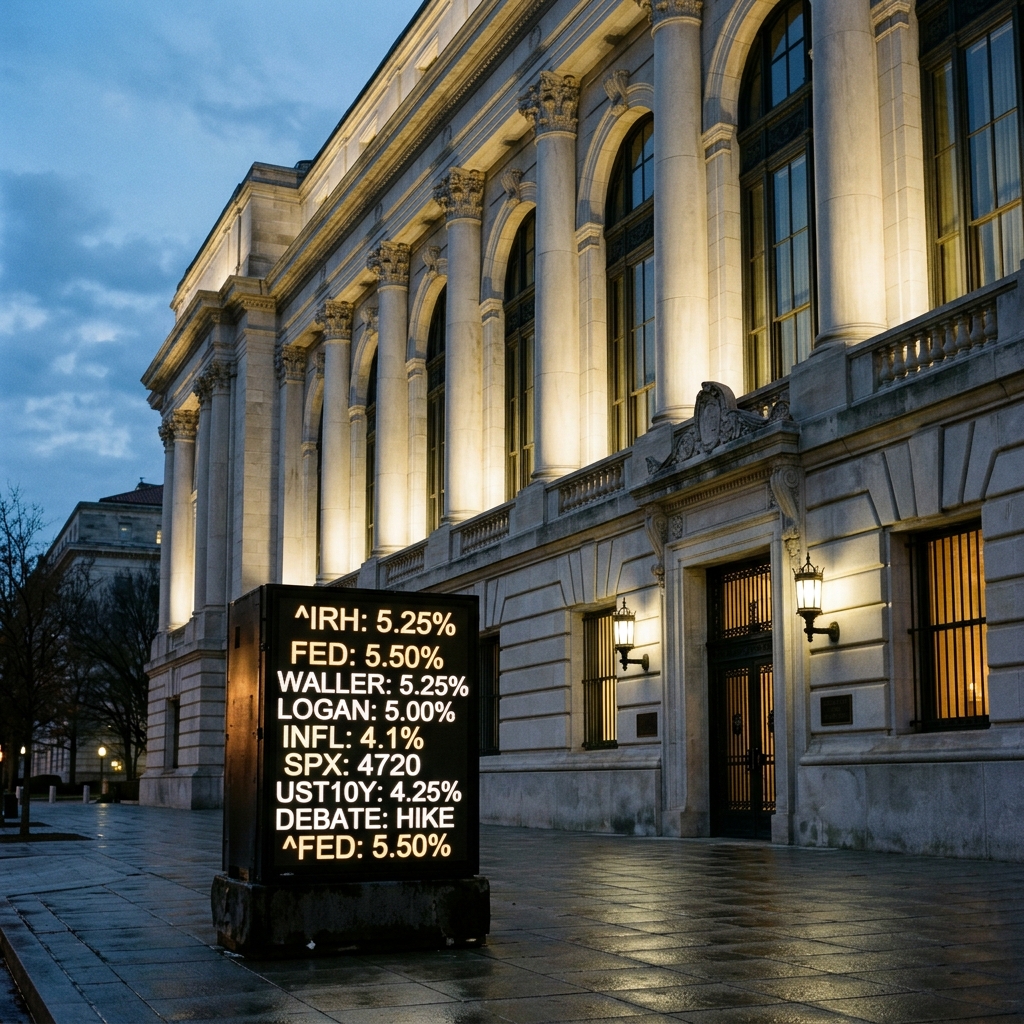
1. Hawkish Fed Talk Shakes Fixed-Income Desks from New York to Toronto
Trading floors in Manhattan and Bay Street scrapped their summer rate-cut models this week. Federal Reserve Governor Christopher Waller and Dallas Fed President Lorie Logan warned that progress on U.S. disinflation has stalled. Waller stated plainly that if inflation figures fail to cool, the Federal Open Market Committee will raise the federal funds rate above its current 5.25% to 5.50% range. Logan echoed the warning. She noted that financial conditions eased too early this year. Treasury yields climbed sharply across the curve, pushing the two-year note past 5.00% and putting government bond desks on the defensive.
The sudden change caught bond managers off guard. Just two months ago, the consensus pointed to three rate cuts before the fourth quarter. That call fell apart after the Bureau of Labor Statistics reported hotter-than-expected Consumer Price Index numbers for three consecutive months. Core service costs, shelter expenses, and wage pressures in the American logistics sector refused to budge. U.S. domestic demand remains stubborn, backed by federal fiscal programs and tight industrial capacity. Logan also observed that neutral rates may now sit well above the historical 2.50% baseline.
The reaction across bilateral credit markets was immediate. Corporate treasurers in Calgary and Montreal shelved new debt offerings bound for the Yankee bond market. Spreads on Canadian five-year sovereign paper widened to more than 110 basis points below equivalent U.S. Treasuries. The gap reflects an economic divide. The American economy continues to add payrolls at a brisk clip, but Canada is running out of steam. Waller's comments forced traders to price in higher borrowing costs for longer, with real odds of another 25 basis point hike.
2. Bank of Canada Faces an Asymmetric Currency and Mortgage Dilemma
Governor Tiff Macklem and the Bank of Canada Governing Council have run out of room. Canada's gross domestic product per capita dropped for six straight quarters, and household consumption is flat. Debt loads sit at roughly 180% of disposable income, mostly tied to five-year fixed and variable mortgages. If the central bank cuts rates to give homeowners some breathing room, the Canadian dollar will take the hit. A weaker loonie pushes up import costs fast, since roughly 75% of Canadian consumer goods and machinery components arrive from the United States.
A policy spread wider than 100 basis points usually brings speculative selling against the Canadian dollar. The exchange rate slipped below 73 cents U.S. after Waller spoke, with options traders targeting 71 cents. Central bank models show that every sustained 10% drop in the loonie adds 25 to 40 basis points to headline inflation over four quarters. Macklem cannot absorb pricier imports while domestic rents and grocery bills remain high. Yet matching Fed rate increases risks triggering defaults across housing markets in Ontario and British Columbia.
Lenders are already running stress tests on these numbers. The Office of the Superintendent of Financial Institutions told federally regulated banks to increase loan-loss reserves for multi-family residential and commercial property portfolios. Canadian chartered banks still carry heavy books of mortgages written in 2020 and 2021 that reset through 2025 and 2026. A hawkish Fed keeps borrowing costs high north of the border, wiping out the rate relief homeowners expected when inflation first pulled back toward 3%.
3. Freight Corridors and Border Supply Chains Face Input Cost Squeeze
The pressure extends straight into cross-border shipping lanes. Auto parts, structural steel, and farm produce moving across the Ambassador Bridge and the Blue Water Bridge rely on fast settlement in U.S. dollars. A stronger greenback forces Canadian Tier-1 auto suppliers to spend more cash for American specialty alloys and electronic components. Crews assemble these parts in southern Ontario before shipping them back to assembly plants in Michigan, Ohio, and Indiana. That currency mismatch drives up operating costs across the entire corridor.
Rail carriers face the same friction. Canadian National and Canadian Pacific Kansas City run intermodal trains from the ports of Vancouver and Prince Rupert into the U.S. Midwest, where fuel surcharges track dollar-priced Brent and West Texas Intermediate contracts. When the U.S. dollar climbs, diesel expenses rise for Canadian shippers paying in local funds. Equipment leases for locomotives, refrigerated boxes, and aircraft are also billed in U.S. dollars. Operating bills grow even if cargo volumes flatten out.
Customs rules make adjusting supply lines difficult. U.S. Customs and Border Protection and the Canada Border Services Agency enforce strict origin limits under the United States-Mexico-Canada Agreement. When cross-border suppliers swap vendors to manage currency risks, they risk violating regional value content minimums. Replacing U.S. parts with domestic or overseas alternatives requires recertification under USMCA panels. That piles administrative work on mid-sized manufacturing plants along the border.
4. Bilateral Capital Allocation Shifts Toward High-Yielding U.S. Assets
Capital is heading south. Institutional investors, including Canada's public pension funds, have parked larger shares of cash into short-term U.S. paper, money market funds, and Treasury bills yielding over 5.30%. The Internal Revenue Service and the Canada Revenue Agency have clear tax treaties covering cross-border interest, but unhedged Canadian accounts can earn higher nominal returns in U.S. dollar assets right now. That shift pulls liquidity out of the Canadian commercial paper market and forces domestic industrial firms to pay higher yields to find buyers.
Private equity firms in the Pacific Northwest and the Great Lakes manufacturing belt are resetting their buyout models. Floating-rate loans tied to the Secured Overnight Financing Rate now carry total interest costs between 8% and 10% for mid-market borrowers. Logan noted that deep corporate cash balances have muted the impact of earlier rate hikes, keeping business investment stronger for longer. Large corporations locked in cheap long-term debt during the pandemic, so the weight of tight policy lands on supply-chain vendors who rely on asset-backed credit lines to cover payroll.
The outlook for the next six months hinges on upcoming U.S. Personal Consumption Expenditures data and Canadian jobs reports. If Waller and Logan stick to this script through early summer, markets will price out any remaining Fed cuts for 2024. Macklem will have to choose between two bad outcomes. He can cut rates to ease the pressure on Canadian homeowners and let the currency slide, or match the Fed to protect the dollar and risk a deeper domestic downturn.