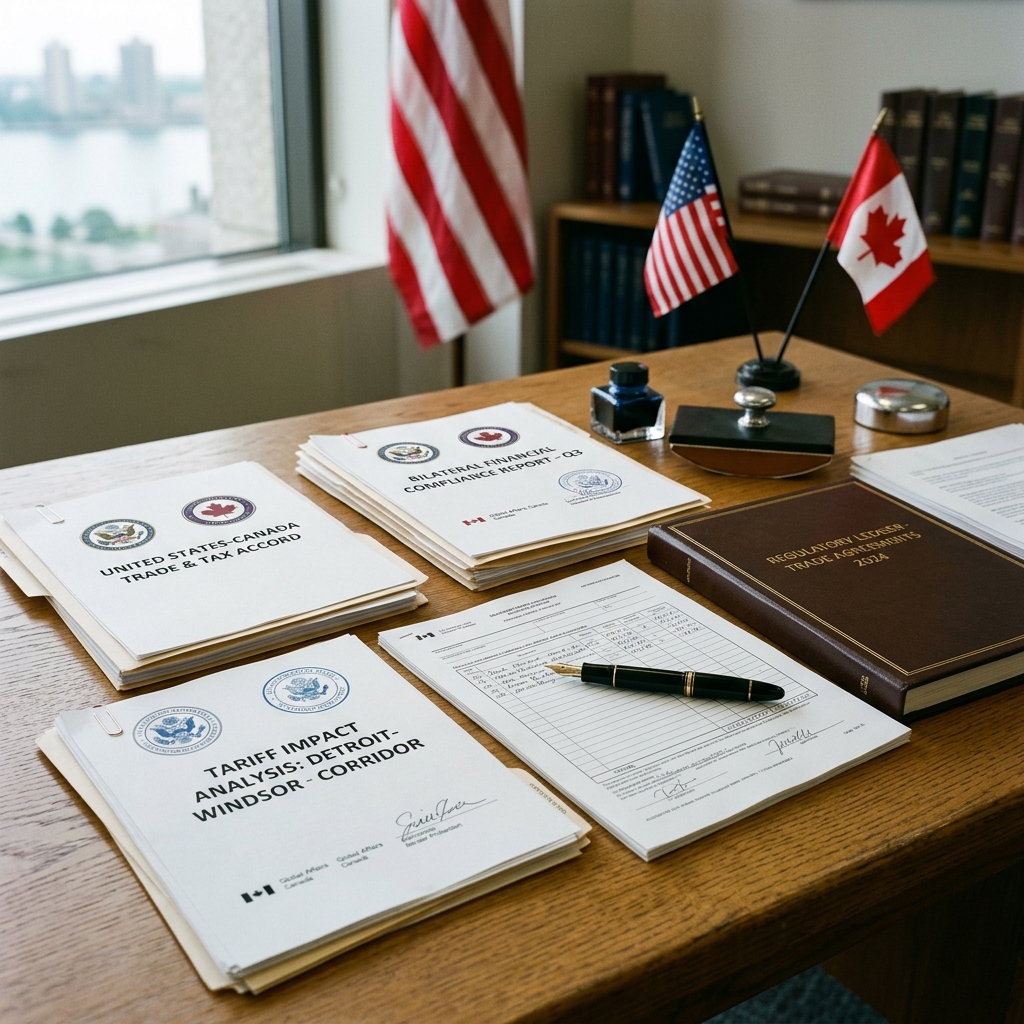
1. Michigan Democrats Mount Pushback Against Federal Tariff Measures
Abdul El-Sayed, director of the Wayne County Department of Health, Human and Veterans Services and a prominent Michigan Democratic voice, has joined state and national lawmakers in resisting proposed tariffs on Canadian goods. The proposal calls for an across-the-board 25 percent levy on Canadian imports under the International Emergency Economic Powers Act. It faces stiff resistance across the industrial Midwest. El-Sayed argues that taxing Canadian trade punishes domestic consumers and fractures cross-border civic partnerships. His position mirrors regional automotive executives, who treat Canadian supply lines as internal production inputs rather than foreign competition.
The political fight points straight to southeast Michigan's bottom line. Wayne County handles tens of thousands of commercial trucks each week across its border crossings. State officials emphasize that Canada is not an overseas mercantilist rival; it buys more goods from Michigan than the state's next four export destinations combined. Slapping taxes on parts arriving from Ontario threatens to stall assembly lines in Detroit, Dearborn, and Warren. That means immediate furloughs for union autoworkers on tight factory schedules.
Trade analysts also see a direct conflict with statutory rules under the United States-Mexico-Canada Agreement. Emergency economic powers give the president broad leeway during national crises, but corporate trade lawyers are preparing challenges to test those limits in court. Meanwhile, members of Michigan's congressional delegation are lobbying federal trade officials for permanent exemptions on USMCA-compliant goods, arguing that regional manufacturing requires tariff-free trade to survive.
2. Ambassador Bridge Logistics and the Just-in-Time Automotive Crisis
The Detroit-Windsor corridor remains the primary hub for North American vehicle manufacturing. The Ambassador Bridge and the Blue Water Bridge in Port Huron carry more than 25 percent of all commercial freight between the United States and Canada. Key parts like stampings, engine blocks, and wire harnesses often cross the Detroit River multiple times before reaching a finished vehicle. U.S. Customs and Border Protection clears these shipments with rapid electronic releases tailored for zero-inventory assembly lines.
A 25 percent tariff would upend that rhythm. General Motors, Ford Motor Company, and Stellantis synchronize their Michigan and southern Ontario operations down to the hour. Tier-one suppliers like Magna International, Linamar, and Martinrea run plants on both sides of the river. If customs brokers must collect 25 percent cash deposits at the border, working capital requirements will surge overnight. Smaller tool-and-die shops operating on net margins under five percent cannot absorb those costs.
Data from regional Federal Reserve banks and the Bank of Canada show that broad tariffs would add roughly $3,000 to the build cost of an average North American light truck. Costs compound because components cross the border repeatedly, racking up duties at each checkpoint. Commercial lenders are already reviewing loan portfolios for Tier-2 and Tier-3 suppliers with heavy debt, warning that border holdups could spark widespread vendor defaults.
3. Retaliatory Measures and Regulatory Gridlock Under USMCA
Officials in Ottawa are preparing an aggressive counter-punch. Finance Canada has drawn up preliminary lists of retaliatory duties modeled on the 2018 Section 232 steel and aluminum fight. Those duties targeted politically sensitive American exports, including Michigan plastics, fabricated metal, and farm commodities. If Canada hits back, Michigan growers shipping soybeans, dairy, and livestock feed to Canadian processors will lose ground to South American exporters overnight.
Border infrastructure cannot easily handle sudden shifts in customs rules. U.S. Customs and Border Protection and the Canada Border Services Agency currently enforce a 75 percent regional value content threshold for duty-free automotive trade under the USMCA. Adding a standalone 25 percent tariff outside that framework creates an administrative nightmare for freight forwarders and customs brokers. Commercial lanes in Detroit and Port Huron would jam up fast, pushing truck backups onto Interstate 75 and Interstate 94.
Trade attorneys expect fast filings under USMCA Chapter 31 dispute panels. The problem is timing. State-to-state panels take months to deliver rulings, offering zero relief to companies forced to post customs bonds today. As a result, manufacturing coalitions are preparing requests for emergency injunctions in the U.S. Court of International Trade, arguing that broad border security claims cannot legally override an active trade treaty with a close ally.
4. Capital Allocation Risks Across the Great Lakes Industrial Basin
Midwest corporate treasurers are stress-testing balance sheets to prepare for volatile trade rules. Private equity groups and industrial holding firms with money parked in cross-border logistics hubs and advanced manufacturing plants face immediate valuation hits. The threat of tariffs has already delayed spending on automated stamping plants in Michigan. Treasury desks are also adjusting foreign exchange hedges as the Canadian dollar slides against the greenback, complicating cross-border procurement contracts.
Rail carriers are taking a hard look at their volumes too. Canadian Pacific Kansas City and regional short lines haul bulk materials, structural steel, and finished vehicles between Montreal, Toronto, Detroit, and Chicago. Any slowdown on the rails shifts freight onto highways, boosting road congestion, diesel emissions, and total shipping costs. At the same time, institutional investors are scrutinizing supplier agreements to see who absorbs tariff liabilities, pushing manufacturers to rewrite vendor terms.
El-Sayed and state Democrats argue that protecting factory jobs means reinforcing these cross-border ties, not cutting them. For decades, Michigan economic development teams have pitched Detroit and Windsor as a unified industrial center. Arbitrary tariffs threaten to split that market apart. That leaves an opening for overseas competitors while domestic plants remain tied down in customs disputes. State leaders want federal policy to support Great Lakes manufacturing rather than pull the rug out from under it.