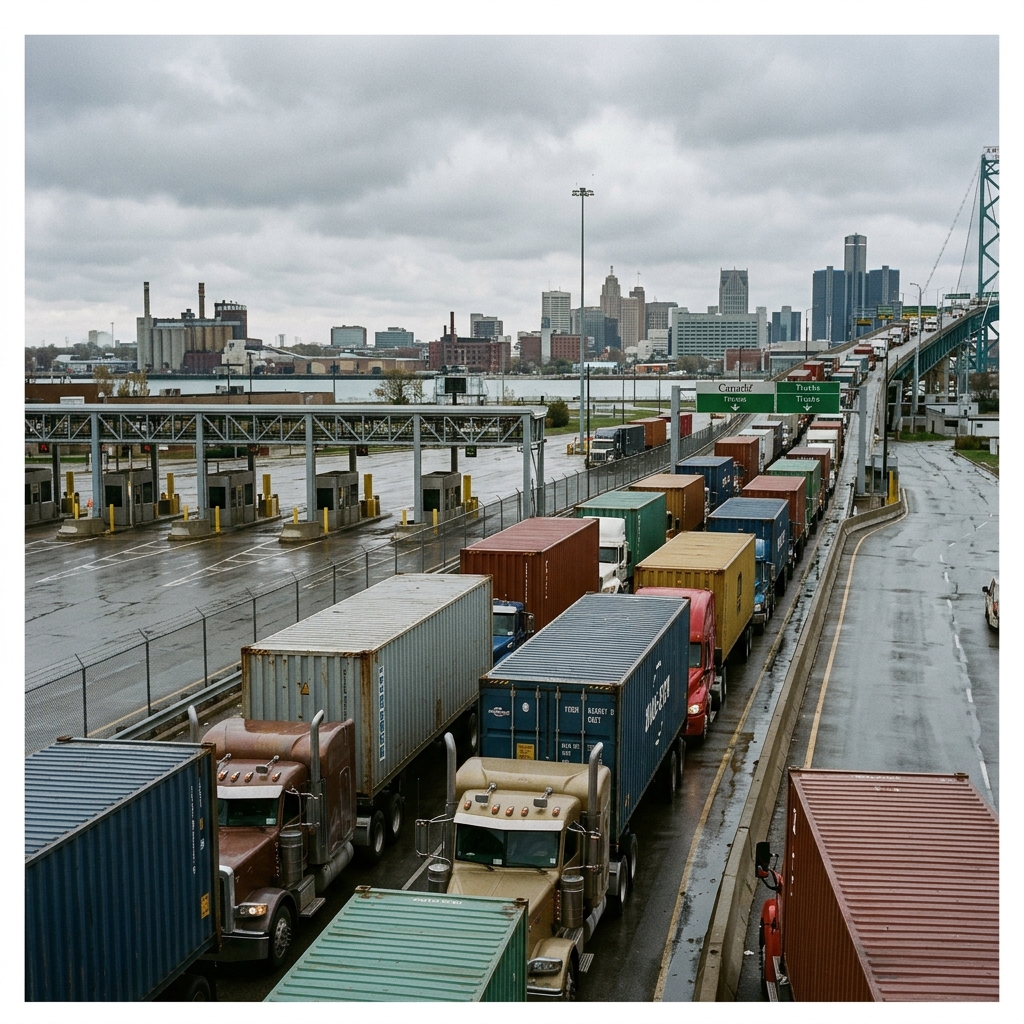
1. Tariff Threat Shatters Decades of Integrated North American Trade
The cross-border economic framework between the United States and Canada faces its sharpest stress test since the 1971 Nixon shock. Donald Trump has pledged a blanket 25 percent tariff on all Canadian imports, citing border security and illicit synthetic opioid flows. The declaration bypassed standard bilateral consultation channels, sending immediate shockwaves through trading desks in Toronto, New York, and Calgary. Nearly 2.7 billion dollars in goods cross the northern border daily under the United States-Mexico-Canada Agreement. A universal tariff would overturn long-standing treaty commitments and break the zero-tariff baseline that manufacturers have relied on for decades.
Market reactions were immediate. The Canadian dollar dropped sharply against the greenback, sliding toward multi-year lows near 71 cents US. Equity markets discounted industrial, rail, and energy equities across both sides of the 49th parallel. Transport operators like Canadian National Railway and Canadian Pacific Kansas City (CPKC) immediately modeled the volume reductions of a sustained border tax. Executives at automotive plants in Ontario and Michigan held emergency strategy calls. Modern supply chains cannot absorb a 25 percent levy without widespread disruption, plant stoppages, and swift retail price increases.
Global capital markets recognize that this dispute differs from the targeted steel and aluminum tariffs of 2018. Jamie McGeever's analysis on EnergyNow.com notes that a comprehensive trade levy against Canada drags the world's most stable industrial alliance into unpredictable transactionalism. Unlike surgical trade remedies targeted at anti-dumping or countervailing duty infractions, a blanket punitive tariff strikes intermediate components as well as finished goods. This structure guarantees that US domestic manufacturers absorb immediate input cost increases before goods reach consumers.
2. Energy Corridors and Refining Margins Face Severe Capital Reallocation
The bilateral energy relationship is the most critical pressure point in this confrontation. Canada exports roughly four million barrels of crude oil per day to the United States, representing over half of total US crude imports. US Gulf Coast and Midwest refineries are chemically optimized to process heavy sour Canadian crude like Western Canadian Select (WCS). These facilities cannot easily swap Canadian crude for lighter domestic shale oil without costly modifications and operational bottlenecks. A 25 percent duty collected by US Customs and Border Protection (CBP) would raise feedstock costs for refiners across Illinois, Indiana, and Ohio.
Midwest consumers would face prompt price increases at the fuel pump. If the tariff takes effect without energy sector exemptions, refiners will either swallow compressed crack spreads or pass costs directly to drivers and airlines. Canadian energy producers could see the WCS discount against West Texas Intermediate (WTI) widen significantly if barrels back up in Alberta storage hubs. The newly expanded Trans Mountain pipeline (TMX) offers alternative egress to Pacific Rim buyers in Asia, but its 890,000 barrel-per-day capacity cannot single-handedly redirect Canada's massive export volumes away from American refineries.
Natural gas flows through pipeline networks spanning Alberta, Saskatchewan, and the US northern border tier also face uncertainty. Bilateral gas trade is physical, continuous, and structurally interdependent. Natural gas heats millions of homes in the US Midwest during freezing winter conditions, while US gas frequently balances Ontario and Quebec heating demand. Taxing these continuous energy deliveries would distort regional power markets, increase utilities bills, and provoke aggressive regulatory resistance from state-level utility commissions in Minnesota, Michigan, and New York.
3. Automotive Freight Along the Windsor-Detroit Corridor Confronts Gridlock
The Windsor-Detroit automotive corridor is the commercial heart of the Great Lakes manufacturing ecosystem. Thousands of trucks transit the Ambassador Bridge and the Blue Water Bridge each day, carrying specialized parts that often cross the border six or seven times during final assembly. Motor vehicle parts manufactured in Ontario feed assembly lines in Michigan, Ohio, and Kentucky under tight, just-in-time delivery schedules. A 25 percent import duty collected on each international border crossing would render the North American auto manufacturing cost model completely unworkable.
Detroit automakers General Motors, Ford, and Stellantis would face immediate margin destruction. The Motor Vehicle Parts Manufacturers' Association in Canada warned that suppliers operate on thin net profit margins, rarely exceeding five to eight percent. An unexpected 25 percent border tax would deplete cash reserves across tier-one and tier-two suppliers within weeks. Automakers would face an impossible dilemma: shut down assembly lines to renegotiate cross-border contracts or absorb billions in unbudgeted import duties, inevitably raising new car prices for American consumers.
Border infrastructure would also experience severe physical bottlenecks. US Customs and Border Protection alongside the Canada Border Services Agency (CBSA) lack the customs auditing systems required to collect 25 percent duties on hundreds of thousands of individual daily shipments without halting logistics flows. Transport delays at highway border inspection plazas would turn key industrial arteries into multi-mile truck queues, interrupting automotive assembly lines in both countries within hours.
4. Central Bank Dilemma, Retaliatory Targets, and the USMCA Framework
The trade stand-off complicates monetary policy for both the Bank of Canada and the Federal Reserve. Bank of Canada Governor Tiff Macklem must balance two conflicting risks: an inflationary imported-cost shock from a weakened Canadian dollar versus a sharp slowdown in gross domestic product. Canada sends nearly 75 percent of its outbound goods to the United States. A sudden trade freeze would slash Canadian real GDP growth, forcing the central bank to contemplate policy rate cuts even as a weaker loonie fuels domestic inflation.
In Ottawa, the federal government is reviewing legal remedies under USMCA Chapter 31 state-to-state dispute settlement rules. A formal USMCA dispute panel takes months to deliver a binding legal ruling, however, while trade duties inflict damage in real time. As a result, the Department of Finance is assembling a list of aggressive retaliatory tariffs on selected American goods. Retaliation lists will focus on products from politically sensitive congressional districts, including agricultural products, industrial chemicals, plastics, bourbon, and consumer appliances, mirroring Canada's response to the 2018 steel tariffs.
The long-term danger lies in the scheduled 2026 joint review of the USMCA. The formal treaty contains a sunset clause requiring all three signatories to approve the agreement's extension. By weaponizing tariffs over border control matters unrelated to trade terms, the White House has introduced institutional instability into cross-border commerce. Corporate leaders, infrastructure investors, and corporate treasurers must now price long-term political risk into an economic corridor previously considered the most predictable and integrated market in the world.