1. White House Rhetoric Derails Ottawa's Carefully Crafted Legal Playbook
President Donald Trump swept aside four years of trade diplomacy this week with a blunt assertion that he does not care about the USMCA. The remark landed as Canadian officials prepared for formal bilateral talks in Washington, instantly resetting expectations across the policy corridor. Ottawa spent months building a defense grounded in strict treaty compliance and integrated energy security. That technical strategy relies on the assumption that the White House views the agreement as binding law. Trump made it clear that existing statutory frameworks will not constrain his trade agenda.
The reaction across Canadian capital markets was swift. The Canadian dollar slipped 42 basis points against the greenback to trade near 71.30 cents US, while energy equities on the Toronto Stock Exchange absorbed sudden selling pressure. Trump originally negotiated the pact to replace NAFTA during his first administration, hailing it as an unmatched victory for domestic manufacturing. His willingness to disown his signature commercial accord reveals a fundamental shift. Tariff threats are no longer merely enforcement mechanisms for specific compliance disputes. They are blunt instruments designed to extract sweeping industrial concessions.
Inside Global Affairs Canada, trade planners scrambled to adjust briefing binders. The Canadian delegation had aimed to keep discussions focused on perimeter security, critical minerals supply chains, and Chinese import diversion. Trump bypassed those agenda items entirely. By treating the trilateral pact as an optional guideline rather than an enforceable treaty, the administration signaled that access to the American consumer base remains conditional. Washington intends to leverage cross-border dependency to rewrite the rules of continental commerce on an ad hoc basis.
2. Article 34.7 Becomes an Active Threat to Continental Capital Allocation
Corporate anxiety centers squarely on the built-in review mechanism under Article 34.7 of the USMCA. The clause mandates that all three partner nations conduct a joint review on July 1, 2026, to decide whether to extend the agreement for another sixteen-year term. If any party refuses to confirm extension, the pact enters an annual review cycle during which tariffs can be reimposed piecemeal. Trade attorneys in Washington note that Trump does not need to formally withdraw under Article 34.6 to paralyze corporate investment across North America.
Uncertainty around the 2026 sunset provisions is already freezing long-term capital expenditure along the industrial spine of the continent. Automotive manufacturers operating across Windsor, Detroit, and Monterrey run just-in-time logistics networks that cross borders six times before final vehicle assembly. These firms cannot commit billions of dollars to next-generation electric vehicle platforms without guaranteed zero-tariff rules of origin. Plant managers are calculating the carrying costs of potential border delays. CFOs must now price tariff risk directly into debt covenants and joint venture contracts.
The Office of the United States Trade Representative has gathered extensive files on alleged Canadian non-compliance. American agricultural lobbies continue to contest Ottawa's supply management quotas for class seven dairy products. USTR officials also target Canada's Online Streaming Act and its three percent Digital Services Tax, which hits major Silicon Valley tech platforms. In past disputes, these frictions moved through Chapter 31 panels. The Trump administration indicates it will bypass international arbitration entirely, preferring direct economic pressure enforced by presidential executive order.
3. Critical Freight Corridors and Energy Flows Face Real-World Chokepoints
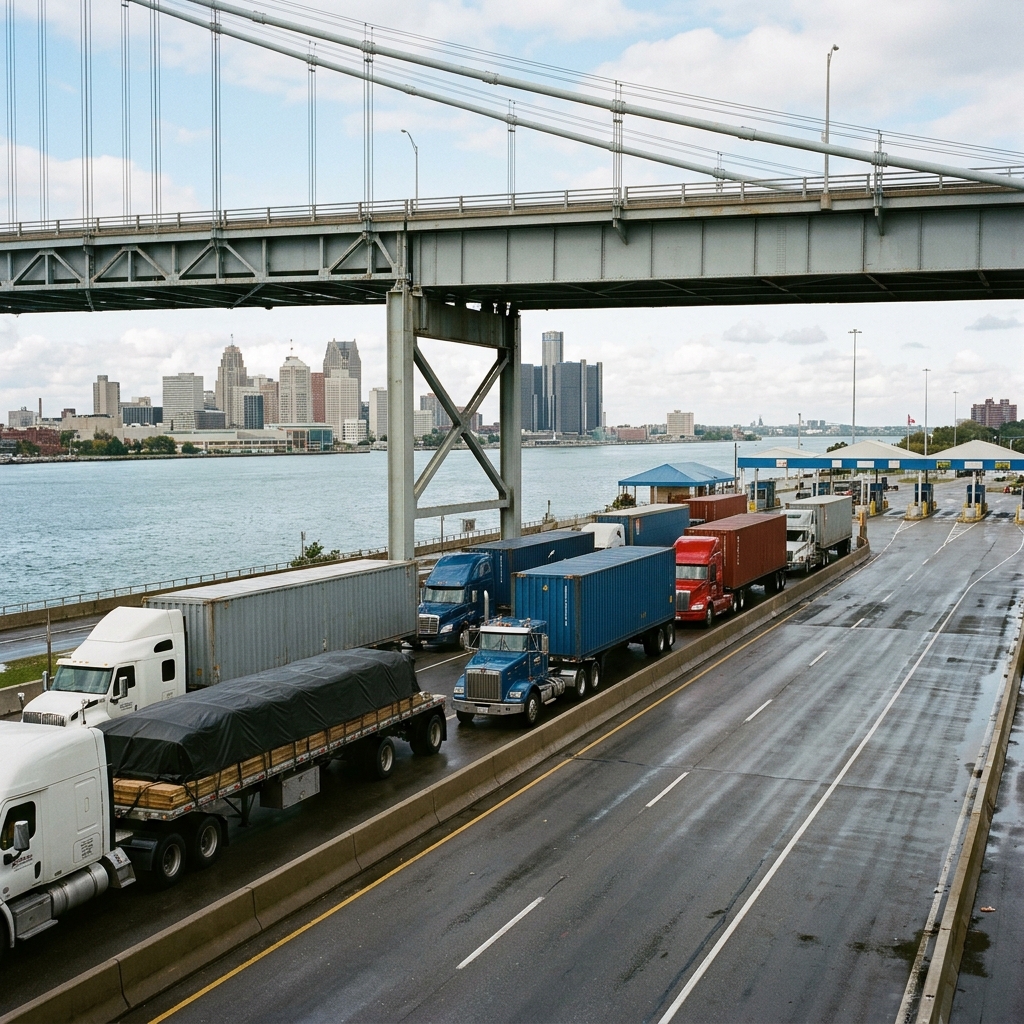
Physical trade flows quantify the sheer scale of the exposure. More than 2.5 billion dollars in two-way goods traverse the northern frontier every single day. The Ambassador Bridge connecting Windsor and Detroit handles twenty-five percent of all surface trade between the two nations, while the Blue Water Bridge carries heavy commercial freight directly into the Midwestern manufacturing core. Any administrative order directing US Customs and Border Protection to conduct enhanced secondary inspections would produce instant supply chain paralysis, backing up tractor-trailers for miles along Ontario Highway 401.
Energy infrastructure presents a unique regulatory paradox in this confrontation. Canadian pipeline networks export over four million barrels per day of Western Canadian Select and synthetic crude to Gulf Coast and Midwest refineries. These heavy crude facilities in Illinois and Texas require Canadian feedstock to operate at baseline margins. Trump's broad-brush tariffs on Canadian imports could disrupt this flow, driving up refined fuel prices for American drivers. Yet, Trump's recent statements suggest domestic fuel price mechanics may take a back seat to broad protectionist goals.
Rail networks face equivalent operational uncertainty. Canadian Pacific Kansas City operates the only single-line rail network connecting Canada, the United States, and Mexico. A return to fractured tariffs or unilateral border fees would gut the commercial logic of this trilateral freight corridor. Intermodal shippers that invested in seamless continental transit must now track customs classification codes under the Harmonized Tariff Schedule. Every freight manifest risks becoming a political battleground between domestic regulators and foreign shippers.
4. Ottawa's Retaliatory Architecture Prepares for Industrial Disruption
Canadian Prime Minister Justin Trudeau and his cabinet have privately activated the federal retaliatory tariff registry. The Department of Finance Canada previously demonstrated its playbook in 2018 by imposing sixteen billion dollars in countermeasures on American steel, aluminum, and targeted consumer products from politically sensitive congressional districts. Officials in Ottawa are preparing a similar response list. It targets agricultural exports from Iowa, bourbon from Kentucky, and manufactured equipment from Ohio, aiming to generate maximum domestic political resistance for the White House.
Retaliation carries grave risks for the Canadian economy, which depends on the United States for three-quarters of its exports. Bank of Canada researchers have warned that an escalating tariff war could shave two full percentage points off national gross domestic product within twelve months. The central bank would face a stagflationary trap: a sinking Canadian dollar creates imported inflation, while falling industrial output argues for aggressive interest rate cuts. Governor Tiff Macklem must balance monetary easing against capital flight toward safe-haven American assets.
The path ahead demands a structural pivot for bilateral corporate strategy. Relying on paper protections in the USMCA is no longer a viable risk management policy for executives in Toronto, Calgary, or Montreal. Companies must accelerate nearshoring within domestic borders, secure direct US footprint expansions to dodge border tariffs, or form cross-border coalitions with American industry groups dependent on Canadian inputs. The continental trade architecture remains in place on paper, but the operational consensus that sustained it has vanished.