1. Bilateral Rhetoric Bypasses Standard Treaty Timelines
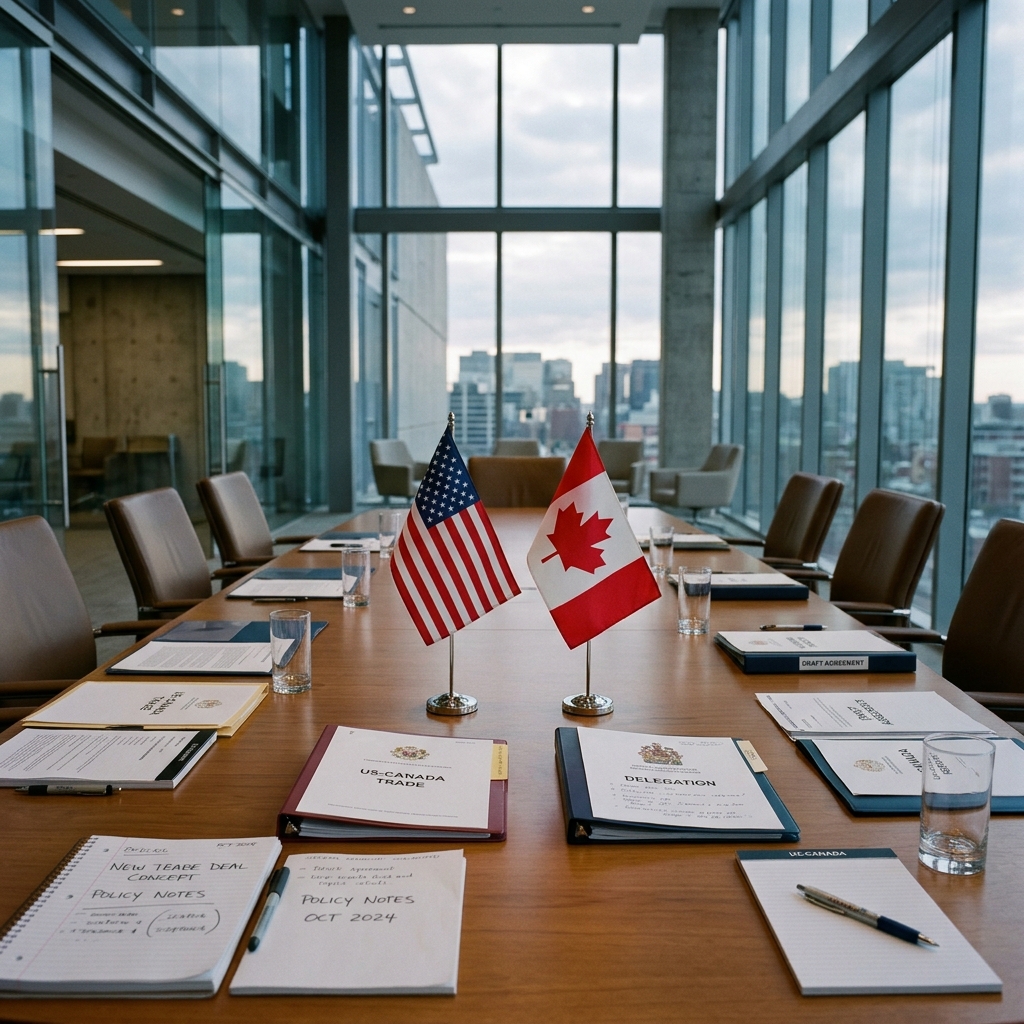
President-elect Donald Trump's assertion that Washington and Ottawa hold the 'concept' of a restructured bilateral trade pact marks an abrupt departure from established diplomatic protocol. Rather than waiting for the prescribed six-year review mechanism embedded in Article 34.7 of the United States-Mexico-Canada Agreement (USMCA), executive rhetoric is forcing trade negotiators into premature positioning. Prime Minister Justin Trudeau's cabinet must now reconcile domestic industrial priorities with an unpredictable White House transition team. The announcement, initially reported through international wire dispatches, leaves senior trade officials on Parliament Hill scrambling to verify whether formal terms exist or if the statement merely reflects a unilateral posture designed to extract immediate Canadian concessions.
The language of a 'concept' mirrors past negotiating tactics deployed during the renegotiation of NAFTA between 2017 and 2019. Back then, Washington routinely used informal pronouncements to destabilize consensus among trading partners and fragment trilateral unity between Canada and Mexico. By suggesting bilateral alignment without publishing concrete legal text, the incoming administration effectively pressures Canadian trade minister Mary Ng and ambassador Kirsten Hillman to offer pre-emptive compromises. Corporate legal counsels in Toronto, Montreal, and New York are already advising institutional clients that current USMCA tariff exemptions cannot be taken for granted as binding certainties across the upcoming four-year presidential term.
Federal agencies including Global Affairs Canada and the Office of the United States Trade Representative (USTR) have not issued corresponding joint communiqués, confirming that this development exists primarily in the political sphere. Canadian provincial premiers, notably Ontario Premier Doug Ford and Alberta Premier Danielle Smith, have responded by hardening their regional agendas. Ford continues to advocate for a separate bilateral Canada-US accord that explicitly sidelines Mexico, while Smith seeks to insulate Canadian crude petroleum exports from punitive tariff threats. This internal regional divergence weakens Ottawa's bargaining leverage before formal bilateral talks even convene.
2. Agricultural and Digital Flashpoints Threaten Sector Stability
At the core of any revised bilateral economic framework lies the perennial dispute over Canada's supply management system for dairy, poultry, and eggs. American farm lobbies, spearheaded by the International Dairy Foods Association and powerful congressional delegations from Wisconsin and upstate New York, contend that Canadian tariff-rate quotas (TRQs) violate Chapter 3 of the USMCA. A dispute settlement panel ruled in Canada's favor in late 2023 regarding TRQ administration, yet Washington trade hawks refuse to accept the verdict. A renegotiated trade concept pushed by the White House will unquestionably demand expanded access for American Class 7 milk products and lower prohibitive out-of-quota duties.
Simultaneously, the Canadian federal government's unilateral Digital Services Tax (DST) - a three percent levy aimed at foreign technology conglomerates generating revenue from Canadian user data - serves as an immediate trigger for retaliatory trade action. Washington perceives the DST as a discriminatory measure aimed directly at American corporate heavyweights like Alphabet, Meta, and Amazon. The Office of the USTR has previously initiated dispute consultations under USMCA Chapter 31 regarding this policy. If the 'concept' referenced by Trump requires abandoning the DST, the Department of Finance in Ottawa faces a multi-billion-dollar budgetary shortfall alongside significant domestic political blowback.
Cross-border manufacturing corridors, particularly the automotive integration established under the 1965 Auto Pact and preserved through USMCA, face renewed operational jeopardy. Current rules of origin require 75 percent North American content and strict labor value content provisions to qualify for duty-free transit. Any bilateral revision that alters steel and aluminum purchase requirements or tightens battery supply-chain origins to counter Chinese components will impose severe capital expenditure demands on assembly plants operating across Windsor, Oakville, and Detroit. Automotive component manufacturers simply cannot absorb continuous legislative redesigns without paring back production runs.
3. Energy Interdependence and Infrastructure Vulnerabilities
Hydrocarbon trade remains the most potent yet volatile element of the Canada-US commercial architecture. Canada supplies over four million barrels of crude oil per day to American refineries, particularly heavy sour blends moving to specialized facilities along the Gulf Coast and across the Midwest. Any trade concept that imposes blanket tariffs on Canadian energy imports would instantly inflate feedstock costs for American operators such as Phillips 66, Marathon Petroleum, and BP. Despite this mutual exposure, persistent litigation surrounding Enbridge's Line 5 pipeline beneath the Straits of Mackinac underscores the legal fragilities governing cross-border energy transport.
Ottawa has invoked the 1977 Transit Pipelines Treaty twice in recent years to block Michigan from shutting down Line 5, demonstrating that energy infrastructure relies on an overlapping web of historical treaties rather than USMCA alone. If the incoming administration conditions trade peace on concessions in other sectors, Canadian pipeline infrastructure could become an overt bargaining chip. Furthermore, the burgeoning trade in critical minerals - essential for defense procurement, nuclear technology, and advanced energy storage - presents an arena where Ottawa holds rare strategic leverage over American industrial consumers who are trying to decouple from Chinese processing dominance.
Electricity transmission represents another sensitive pressure point. Hydro-Québec and the Ontario energy grid export substantial clean power to New York State and New England during peak winter and summer demand windows. A disruptive trade doctrine that undermines wholesale power purchase agreements risks triggering severe reliability concerns in major American metropolitan centers. Institutional infrastructure investors are monitoring these developments with heightened scrutiny, scaling back commitments to transboundary transmission assets until clear regulatory parameters replace erratic public pronouncements from Washington.
4. Currency Volatility and Institutional Investor Strategy
Foreign exchange markets reacted instantaneously to the news dispatch, with the Canadian dollar swinging sharply against the US greenback. Because Canada sends more than 75 percent of its merchandise exports to American buyers, foreign exchange traders view the loonie as a direct proxy for bilateral trade tension. The Bank of Canada, already managing domestic economic deceleration and divergence from Federal Reserve monetary policy, faces amplified currency depreciation risks if cross-border trade friction worsens. A persistently weak loonie increases import costs for Canadian businesses, frustrating central bank efforts to keep inflation anchored near its two percent midpoint.
Corporate treasurers across both nations are rapidly adjusting their foreign currency hedging ratios to protect cash flows against trade policy shocks. For Canadian mid-market enterprises lacking sophisticated derivatives capabilities, protracted trade ambiguity threatens capital investment schedules and hiring intentions. Private equity firms and institutional credit funds are actively pricing higher risk premiums into cross-border mergers and acquisitions, particularly deals exposed to customs clearance disputes, border carbon adjustments, or contested supply-chain provenance. The cost of financing North American cross-border operations is trending higher across all asset classes.
Ultimately, navigating this period of regulatory unpredictability requires institutional leaders to distinguish between tactical bluster and statutory reality. The USMCA remains the governing legal framework until formal notices are exchanged under Article 34.7 in 2026. Any substantive alteration to existing tariff schedules demands rigorous congressional approval under Trade Promotion Authority statutes in the United States, as well as statutory implementation through Parliament in Canada. While political declarations generate market noise and short-term volatility, institutional investors must base multi-year asset allocations on codified legal text rather than the ambiguous 'concept' of a trade deal.