1. Negotiators Reconvene in Washington as Clock Runs on Border Demands
Trade envoys from Ottawa and Washington met behind closed doors this morning after the White House issued a firm tariff deadline. Under the proposed executive order, imports across all sectors face a 25 percent duty unless Canada tightens border security and aligns its external tariffs on Chinese steel with American rates. The Office of the United States Trade Representative confirmed the discussions took place but did not release an agenda. Canadian delegates brought customs manifests from the Canada Border Services Agency to prove that interdiction efforts have already increased.
Every day, more than 3.6 billion Canadian dollars in goods move across the border. Department of Finance Canada models indicate that a 25 percent tariff lasting two quarters would reduce Canadian gross domestic product by 1.8 percent. Across the table, U.S. Treasury Department models project immediate consumer price index jumps in border states. Tensions remain high because the White House linked commercial trade to border enforcement mandates, bypassing standard consultation protocols.
The talks run on a sixty-day clock that wraps up just as preliminary work starts on the 2026 USMCA review. Ottawa treats the deadline as a tactic to force trade concessions early. Canadian Ambassador Kirsten Hillman said before the meeting that trade remedies belong under USMCA Chapter 31 dispute panels. Washington argued instead that the International Emergency Economic Powers Act gives the president authority to intervene directly.
2. Crude Balances and PADD 2 Refiners Confront Hardisty Price Gouging
Energy desks moved fast on the announcement. At the Hardisty hub in Alberta, Western Canadian Select widened its discount against West Texas Intermediate by 2 dollars and 40 cents a barrel, closing at 15 dollars and 80 cents. Traders dumped Canadian heavy grades, betting that Midwest and Gulf Coast refiners will cut orders if customs agents at Coutts and Pembina begin collecting import bonds. Refineries across PADD 2 depend on Canadian crude for over 60 percent of their daily intake.
Enbridge and TC Energy maintained regular pump rates on the Mainline and Keystone systems, yet shippers scrambled to lock down immediate storage capacity. A 25 percent import duty adds roughly 14 dollars to the delivered cost of a Canadian barrel sent to Illinois or Minnesota. The American Fuel and Petrochemical Manufacturers told the Department of Energy that prompt supply risks are real. Several complex Midwest facilities cannot switch from heavy Canadian crude on short notice.
Canadian natural gas deliveries along the Alliance and Empress corridors face similar friction. The Canada Energy Regulator met with provincial energy ministries to review counter-tariffs. Leaders in Alberta and British Columbia cautioned that export limits on crude oil and hydroelectricity remain on the table. Ottawa is reluctant to break continental energy flows, but western provinces are demanding swift action to protect oil patch capital spending from political disruption.
3. Automotive Corridors and Border Crossings Face Structural Freight Delays
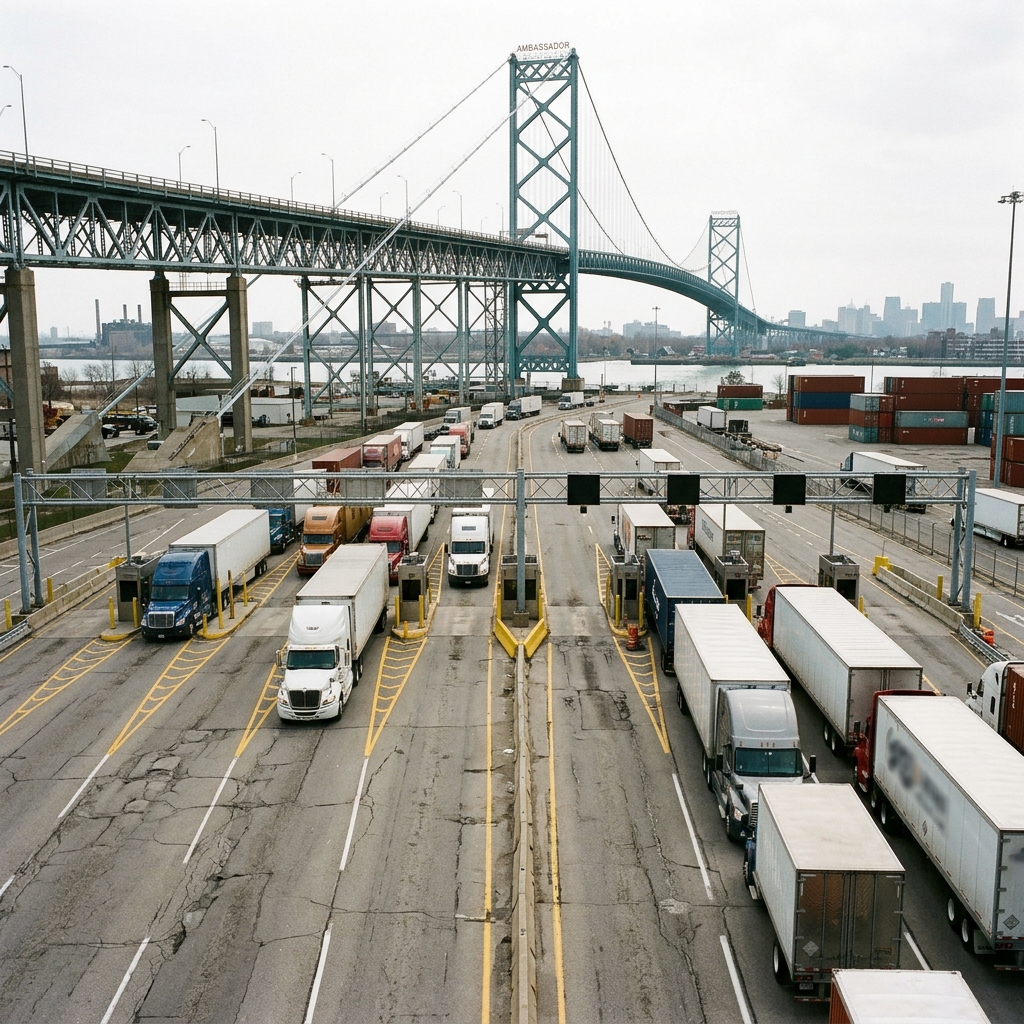
The Detroit-Windsor corridor sits directly in the line of fire. Parts often cross the Ambassador Bridge seven times before rolling off assembly lines in Ontario or Michigan. A sudden border levy enforced by U.S. Customs and Border Protection would upend just-in-time operations at Ford, General Motors, and Stellantis. Parts associations calculate that border friction will cost the sector more than 120 million dollars during the first week.
Freight operators on both sides of the Blue Water Bridge between Sarnia and Port Huron started mapping alternate plans. The Canadian Trucking Alliance warned that mandatory duty collections will choke commercial lanes, backing up rigs along Highway 402 for miles. Trucking firms cannot carry costly bond fees without charging manufacturers extra. Rail carriers Canadian National and CPKC warned shippers to prepare for clearance delays at International Falls, Minnesota, and Portal, North Dakota, while customs brokers update harmonized tariff schedules.
Under USMCA rules of origin, passenger vehicles require 75 percent North American parts to clear customs duty-free. If the White House suspends preferential access through emergency powers, carmakers must cover baseline Most Favored Nation tariffs plus the new 25 percent levy. The Motor & Equipment Manufacturers Association informed congressional committees that added expenses would shut down shifts within forty-eight hours, putting tens of thousands of factory jobs at risk across the Great Lakes.
4. Monetary Policy Divergence and Institutional Fallout for USMCA
The dispute complicates strategy for central banks on both sides of the border. The Bank of Canada, already cutting its overnight rate to prop up employment, now contends with a weaker exchange rate. The Canadian dollar dropped 65 basis points against the U.S. dollar to 71.40 cents after the announcement. A softer currency raises the price of imported American machinery, cutting into the benefits of low interest rates and keeping core inflation sticky in Canada.
Federal Reserve officials view the tariff threat as an upside risk for goods inflation. If tariffs drive up the cost of Canadian lumber, aluminum, and industrial chemicals, those price increases will reach consumer price indexes within six months. Federal Reserve research notes that cross-border shipping delays lower overall factory output. Financial markets adjusted quickly. Federal funds futures now reflect fewer rate cuts over the next nine months.
The larger concern is the erosion of standard commercial rules across North America. Using emergency decrees to skirt USMCA dispute panels weakens the legal foundation that guided cross-border investment for thirty years. Corporate treasurers are freezing capital outlays until rules clear up. Without a workable deal before the deadline, trade between the two countries faces retaliatory tariffs, broken logistics networks, and persistent regulatory friction.