1. Judicial Restructuring Strips Cross-Border Agencies of Regulatory Discretion
The United States Supreme Court upended four decades of administrative law by ending Chevron deference, a doctrine that previously required federal judges to defer to agency interpretations of ambiguous statutes. The decision fundamentally reshapes the legal framework governing cross-border commerce between the United States and Canada. Federal agencies such as U.S. Customs and Border Protection, the Environmental Protection Agency, and the Department of Commerce now face aggressive judicial review for every tariff classification, emissions rule, and administrative decree. Canadian industrial exporters, who trade more than 2.5 billion dollars in daily cross-border goods, must now confront an unpredictable judicial system in Washington.
The timing of the ruling creates an immediate strategic challenge for Ottawa. The Canada-United States-Mexico Agreement contains a sunset clause under Article 34.7 that mandates a formal joint review in July 2026. Prior to the Supreme Court ruling, trade negotiators often resolved contentious bilateral issues through administrative memoranda of understanding or flexible agency enforcement discretion. That strategy no longer works. When US federal judges possess the mandate to substitute their own statutory interpretations for agency expertise, administrative promises lose their legal weight. Canadian businesses can no longer count on U.S. executive branch assurances to maintain predictable market access.
Cross-border litigation is already accelerating across federal dockets. Commercial disputes that previously ended at the agency level are moving directly into federal district courts and the Court of International Trade. For corporate counsel in Calgary, Toronto, and Montreal, the loss of agency finality creates significant corporate overhead. Bilateral supply chains operate on tight margins, where inventory moves across borders within hours. The sudden prospect of contradictory federal court rulings in different circuits threatens to fragment continental trade lanes. This fragmentation forces both sovereign governments to reconsider how they write and enforce trade treaties.
2. Energy Pipelines and Freight Infrastructure Move into Legal Crosshairs
The Canadian energy sector faces immediate exposure under this legal environment. Bilateral pipeline corridors, including Enbridge Line 5 through the Great Lakes and cross-border crude interconnections in Alberta and Saskatchewan, rely on permits from the U.S. Army Corps of Engineers and the Federal Energy Regulatory Commission. Environmental litigants are already utilizing the Supreme Court ruling to contest agency authorizations for these energy assets. Without administrative deference protecting agency environmental impact statements, cross-border pipeline permits face protracted court battles. A single adverse ruling from a federal appeals court could halt crude deliveries valued in billions of dollars.
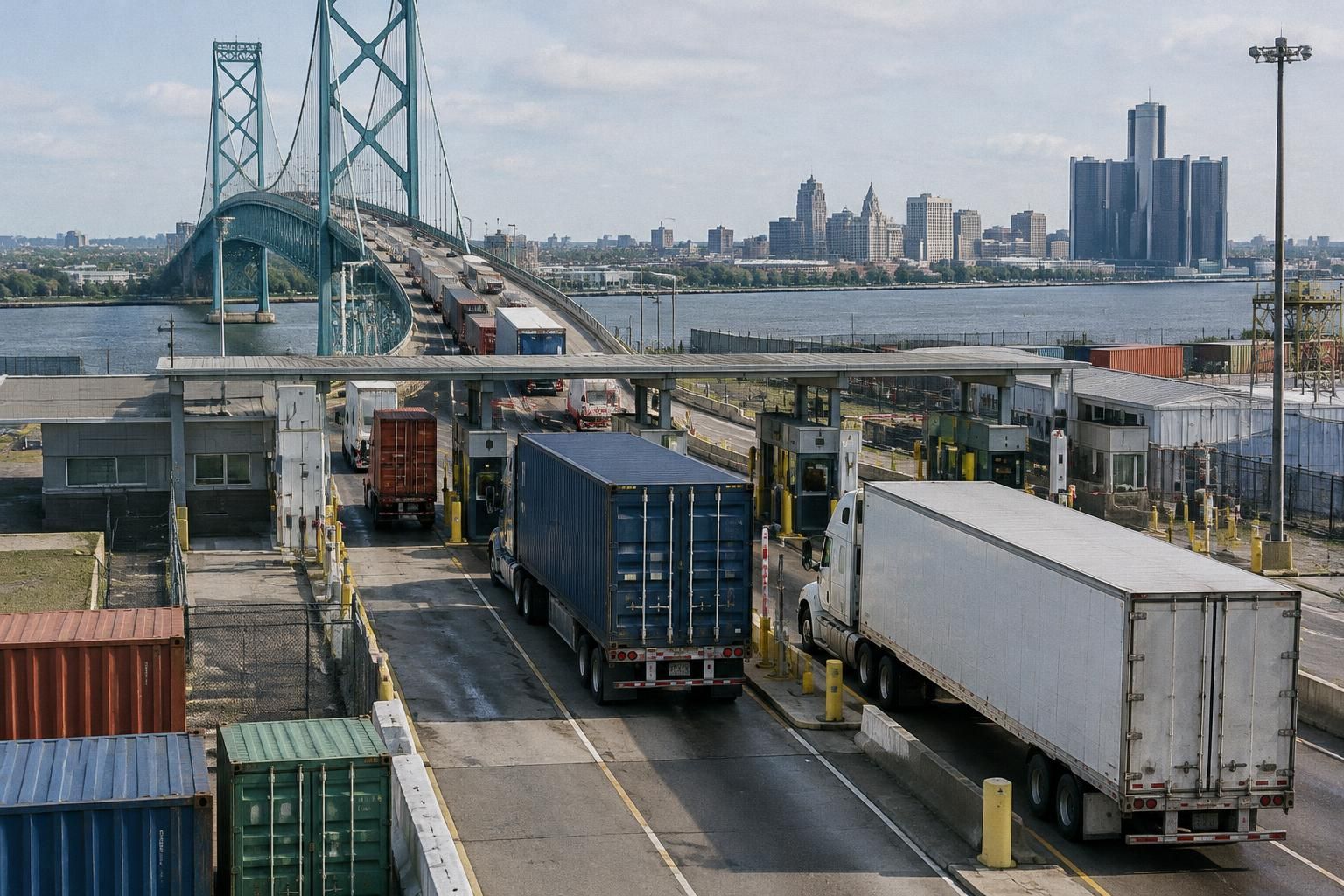
Rail and automotive supply lines also face mounting friction at major border ports. Canadian Pacific Kansas City and Canadian National Railway operate integrated networks to move grain, potash, and auto parts through Chicago and Detroit. In the past, U.S. Customs and Border Protection exercised regulatory discretion to apply rules of origin and clear container shipments efficiently. Under current court scrutiny, domestic industry groups can challenge CBP determinations if they believe enforcement is too lenient on imported Canadian components. The Ambassador Bridge and Blue Water Bridge border plazas risk processing delays if customs officers modify standard clearance practices to avoid domestic litigation.
The financial implications extend directly to capital allocation and debt markets. Canadian energy producers plan multi-decade capital expenditures around stable transit agreements with Gulf Coast and Midwest refineries. When pipeline easements and cross-border presidential permits become vulnerable to judicial invalidation, debt financing costs increase. Corporate treasurers must factor larger legal risk premiums into their balance sheets. This shift raises borrowing costs by 25 to 50 basis points on cross-border infrastructure bonds. Energy capital, which requires absolute regulatory clarity, risks flowing toward domestic US projects instead of integrated North American pipeline ventures.
3. The 2026 CUSMA Joint Review Becomes a Battle over Explicit Statutory Text
Article 34.7 of CUSMA requires Canada, the United States, and Mexico to conduct a joint review of the trade pact six years after its entry into force. If all three parties agree, the treaty extends for another sixteen-year term. If one party refuses, the agreement enters an annual review cycle until it reaches its sixteen-year expiration date. The US Supreme Court decision forces Canadian trade negotiators to demand explicit, ironclad statutory language during these 2026 talks. Vague compromise text, previously used to bypass sensitive political friction points, now carries dangerous legal liability in American courts.
Rules of origin in the automotive sector represent the clearest example of this structural risk. A CUSMA dispute panel previously ruled against the United States regarding the methodology for calculating regional value content in passenger vehicles. Despite that panel victory for Canada and Mexico, the Office of the U.S. Trade Representative resisted full implementation. In a post-Chevron legal environment, private US trade associations can file lawsuits challenging any federal agency rule that adopts the panel interpretation. Canadian auto parts suppliers in southern Ontario need the 2026 review to write these calculation formulas directly into primary treaty text.
Agricultural trade provisions face a similar dilemma. Dairy tariff-rate quotas have generated multiple dispute panels under CUSMA Chapter 31, with American dairy groups repeatedly challenging Canadian market barriers. If the U.S. Department of Agriculture or USTR attempts to establish negotiated regulatory settlements, domestic groups can bypass those agreements and demand strict judicial enforcement of federal trade statutes. Ottawa cannot rely on informal executive agreements to protect supply-managed sectors. Every dairy concession, tariff quota allocation, and sanitary standard must be defined down to the exact word to prevent American courts from invalidating bilateral administrative pacts.
4. Tactical Realignment in Ottawa Demands Aggressive Trade Litigation Defense
Global Affairs Canada and the Department of Finance are shifting their tactical playbook ahead of the 2026 negotiations. Officials in Ottawa previously maintained regular diplomatic channels with the U.S. Department of Commerce and USTR to resolve regulatory frictions quietly. Now, federal officials must coordinate directly with private Canadian corporate counsel to intervene as interested parties in US federal court dockets. Canada can no longer rely on diplomatic appeals when the real decisions occur in federal courtrooms in Washington and the Fifth Circuit. Bilateral economic strategy must integrate trade litigation with treaty negotiation.
Provincial governments are also mobilizing legal resources to safeguard cross-border market access. Energy ministries in Alberta and Saskatchewan are funding legal monitoring teams in Washington to track federal administrative appeals affecting hydrocarbon exports. At the same time, the Ontario government is working with domestic manufacturing coalitions to verify that supply chains comply with strict customs definitions. The Bank of Canada has noted that persistent regulatory unpredictability suppresses private non-residential business investment across export-oriented sectors. If Canadian firms cannot predict trade enforcement rules, they hold back on manufacturing equipment investments and factory expansions.
The 2026 CUSMA review will not be a routine procedural renewal. The United States Supreme Court altered the domestic legal system and shifted regulatory power from executive agencies to federal judges. For Canada, this change eliminates the traditional safety net of administrative compromise. Trade negotiators in Ottawa must approach the upcoming negotiations with absolute precision. They must write unambiguous provisions into the treaty text. Failure to secure concrete language will leave Canadian industries vulnerable to endless legal challenges in American courts. This exposure threatens billions of dollars in bilateral trade across the North American corridor.