1. Reason Magazine's Dairy Case Puts a Cheese Vat on the Tariff Line
Reason Magazine's report centers on a cross-border dairy processor that buys American milk components and turns them into cheese sold as Canadian product. The model is simple on a plant floor: load milk protein concentrate or ultrafiltered milk in the United States, ship it to a Canadian cheese vat, add cultures and rennet, and cut blocks for Canadian buyers. The border is where the simplicity ends. Canada's dairy supply management system controls price and volume, and its tariff schedule can turn a routine input into a dutiable event. The firm's expansion plan depends on staying inside a narrow quota window.
The Reason story matters because it shows how a tariff can reach into a factory before a finished cheese block ever crosses a border. The company ships milk solids that can be classified as milk protein concentrate, skim milk powder, or an ultrafiltered milk ingredient. Each category carries different tariff treatment under USMCA and different licensing rules. A customs officer at CBSA or CBP can change the economics with one classification decision. The processor's plan therefore depends on legal definitions as much as on dairy markets.
The company's problem is not a lack of American milk. U.S. dairy farmers produce more milk than the domestic market absorbs, and processors have built export channels for components that travel well. The problem is Canadian dairy policy. Canada protects its farmers with quotas and high over-quota tariffs, and it admits limited volumes through tariff-rate quotas. A cheese plant that relies on imported U.S. components must win a quota allocation or pay a rate that can exceed the value of the input. Reason's report turns that policy into a specific business plan under pressure.
2. USMCA Tariff-Rate Quotas and Supply Management Set the Real Cost of a Cheese Block
Canada's dairy tariff schedule is the first number a processor checks. Over-quota tariffs run as high as 245.5% for cheese, 298.5% for butter, and 201.5% for skim milk powder. USMCA created tariff-rate quotas that allow limited duty-free access for U.S. dairy products, but the quotas are finite and administered by Canada. The company in Reason's report must fit its American milk components into those quota lines or absorb a duty that destroys gross margin. A cheese block that looks profitable at the farm gate can become a loss at the border.
The regulatory chain runs through CBP and CBSA. CBP controls U.S. export documentation and can verify origin and valuation. CBSA enforces Canadian import permits, tariff classifications, and TRQ allocations. A shipment labeled as milk protein concentrate can face a different duty than a shipment labeled as skim milk powder. The difference is not academic. Canadian dairy processors have fought over these definitions for years, and USMCA dispute panels have reviewed Canadian quota administration. The Reason case adds a private company's balance sheet to that long policy argument.
Supply management adds a second layer. Canadian dairy farmers hold quota, and processors pay administered prices for domestic milk. The system limits how much milk enters the Canadian market and keeps domestic prices above U.S. levels. A processor that uses American milk components can lower input cost, but it must comply with Canadian compositional standards and labeling rules. The Canadian Food Inspection Agency enforces those standards. The company's plan therefore needs three approvals at once: a quota allocation, a customs classification, and a product standard. Missing one can stop the line.
3. Freight, Currency, and Tax Compliance Add Basis Points to Every Truckload
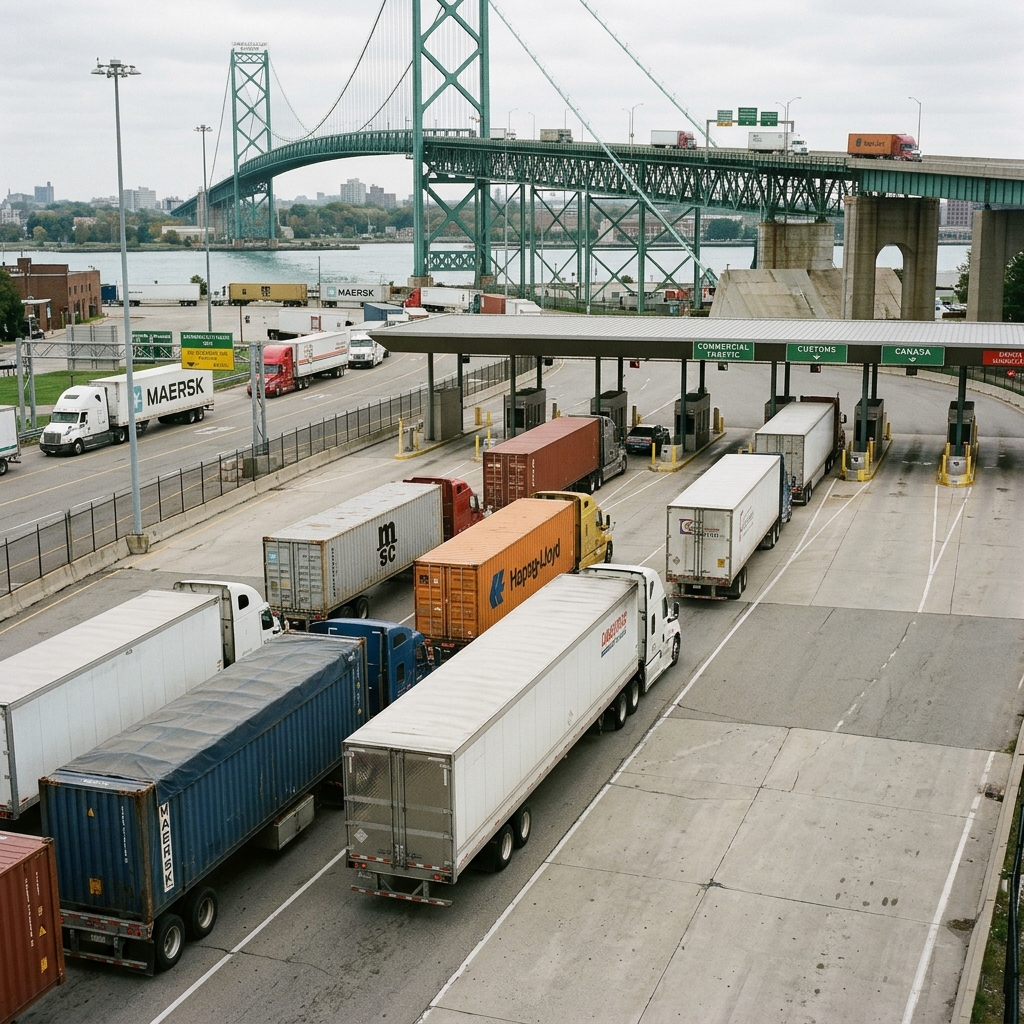
The physical supply chain is short but expensive. A tanker or truckload of U.S. milk components can cross the Ambassador Bridge at Detroit-Windsor or the Blue Water Bridge at Port Huron-Sarnia. Rail moves can ride CPKC networks from the U.S. Midwest into Ontario or Quebec. Each handoff adds customs brokerage fees, inspection risk, and working capital. A 100 basis point swing in the Canada-U.S. exchange rate can change the landed cost of American milk by more than a processor's operating margin. The Bank of Canada and the Federal Reserve set the rate backdrop, but the border sets the cash conversion cycle.
Tax compliance is another cost line. The Canadian subsidiary must satisfy CRA transfer pricing rules on the price it pays for U.S. milk components. The U.S. parent must satisfy IRS transfer pricing rules on the same transaction. A customs valuation that differs from the transfer price can trigger penalties, retroactive assessments, and double taxation. The company also faces Canadian GST/HST and U.S. state tax filings. These are not side issues for a dairy processor. They determine whether the American milk can enter Canada at a cost that leaves room for cheese making.
Freight corridors matter because dairy components are heavy and perishable. A delay at the Pacific Gateway or a rail congestion event on CPKC can push a shipment past its use-by window. The processor must hold safety stock, and safety stock ties up cash. Higher interest rates from the Bank of Canada or the Federal Reserve raise the cost of that inventory. The Reason report's company is small enough that a two-week customs hold can freeze its expansion. Large processors can absorb the hit. A single-plant operator cannot.
4. Bilateral Outlook: A Narrow Path for Dairy Processors if Tariff Lines Hold
The near-term outlook depends on three decisions outside the company's control. First, Canada's TRQ allocation for the dairy year. Second, CBP and CBSA classification of the company's milk inputs. Third, any USMCA dispute panel ruling on Canadian dairy quota administration. If all three break in the company's favor, the plan can proceed with modest capital spending and a focused U.S. supply chain. If any one breaks against it, the tariff bill can exceed the project's annual revenue. That stark risk is why the Reason story has drawn attention beyond dairy circles.
For the broader U.S.-Canada corridor, the case reinforces a hard rule. USMCA lowers tariffs only inside quota and only for goods that meet rules of origin. Dairy is one of the most protected sectors in North America, and both governments defend their farm lobbies. U.S. dairy exporters want more Canadian market access. Canadian dairy farmers want to keep supply management intact. The company in Reason's report sits between those positions. Its business model is a bet that a small quota window and a favorable tariff classification will survive the next round of bilateral friction.
Executives and investors should watch four indicators. The first is the next Canadian TRQ allocation notice. The second is CBP and CBSA ruling activity on milk protein concentrate and ultrafiltered milk. The third is the Bank of Canada and Federal Reserve policy path, because rate differentials move the landed cost of U.S. inputs. The fourth is USMCA dispute panel scheduling. A favorable ruling can reopen planning. A negative ruling can close it. The Reason Magazine case is a useful test case for any cross-border food processor that depends on a tariff line.