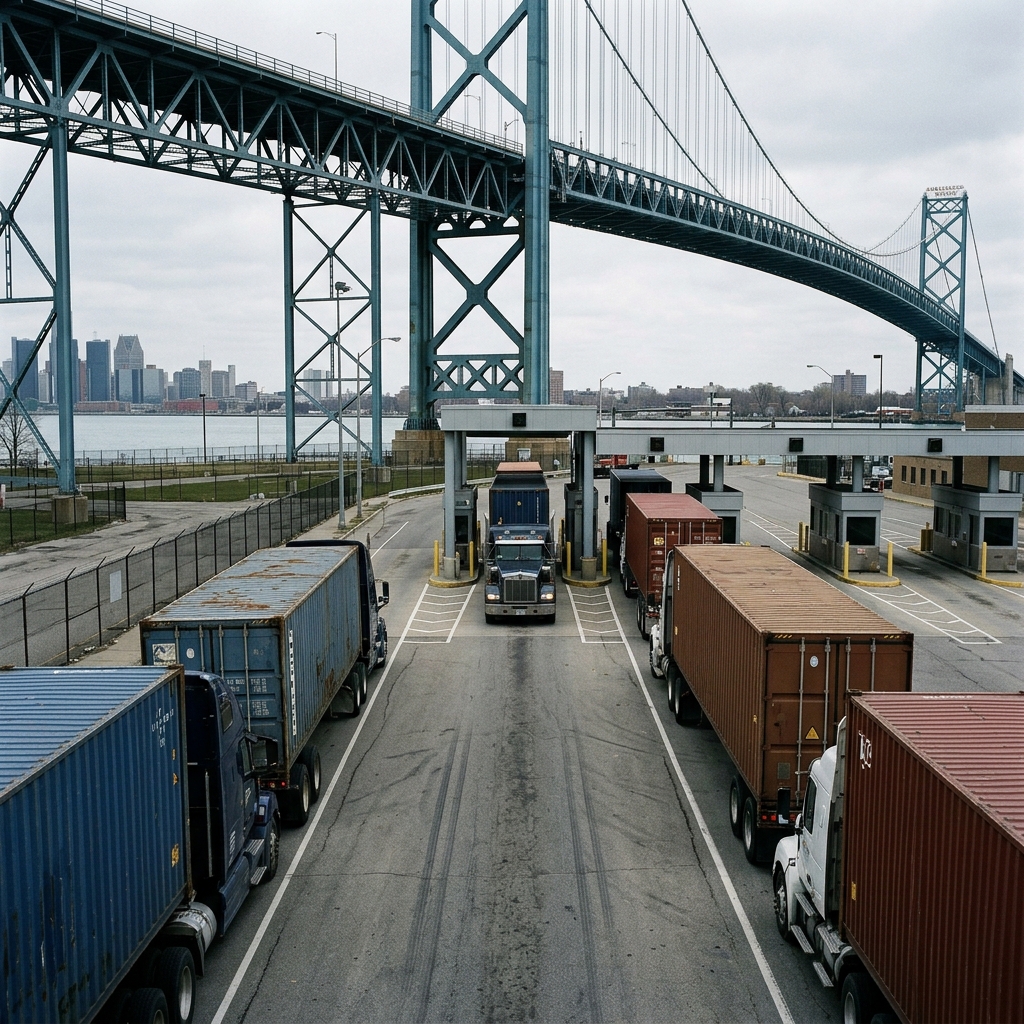
1. Border Checkpoints Enforce Immediate Border Taxes
The enforcement directives reached US entry ports without any administrative grace period. Starting at 12:01 AM Eastern, US Customs and Border Protection began assessing 50 percent ad valorem tariffs on commercial freight arriving from Canada, upending three decades of tightly integrated cross-border supply chains. Freight haulers quickly backed up along the Blue Water Bridge in Port Huron and the Ambassador Bridge between Windsor and Detroit. Dispatchers worked through the pre-dawn hours to re-classify shipments under emergency bonded warehouse entries, racing to avoid immediate duties on auto parts and raw industrial materials.
The White House tariff order relies on executive national security powers, bypassing Chapter 10 dispute mechanisms under the USMCA. Currency markets reacted instantly. The Canadian dollar dropped 140 basis points in overnight trading to roughly 69.80 US cents, while Canadian two-year benchmark bond yields fell 18 basis points as traders factored in a faster easing cycle from the Bank of Canada. Governor Tiff Macklem now confronts a severe demand shock capable of dragging Canadian gross domestic product into contraction by the third quarter.
Industrial plants on both sides of the border are putting non-essential purchasing on ice. According to the Automotive Parts Manufacturers' Association, parts crossing the border up to eight times during assembly will incur cumulative cost spikes of 30 percent within 48 hours. Tier-1 suppliers in Ontario and Michigan have ordered logistics teams to park non-urgent loads in holding yards until customs lawyers clarify whether specific tariff lines contain exemptions for goods already in transit.
2. Ottawa Deploys Carney to Coordinate Retaliatory Surtaxes
Ottawa moved swiftly from diplomatic protests to economic countermeasures. Mark Carney, the former governor of the Bank of Canada and the Bank of England, took the podium at the National Press Theatre to unveil the federal response plan. Carney made it clear that Canada will not absorb unilateral tariffs quietly, pledging a dollar-for-dollar package targeted directly at politically sensitive US industrial and agricultural regions. The strategy follows the blueprint Ottawa used during the 2018 steel and aluminum dispute.
The Department of Finance is assembling a target list covering more than 150 billion Canadian dollars in goods. The proposed surtaxes concentrate on Midwestern agricultural exports, Gulf Coast plastics, and refined petroleum shipments bound for Ontario and Quebec. The Canada Revenue Agency and the Canada Border Services Agency will collect the surtaxes under the Customs Tariff Act. Carney noted that officials will focus on goods with accessible alternate suppliers abroad to prevent domestic consumer prices from spiking.
Canadian business groups endorsed the countermeasures while bracing for a difficult road ahead. The Canadian Chamber of Commerce pointed out that domestic manufacturers cannot survive prolonged 50 percent duties on US sales. In an emergency briefing with provincial premiers, Carney called for cross-party unity, describing the response as a necessary defense of Canadian economic independence. He added that the federal government will introduce targeted tax offsets to protect private equity and foreign direct investment in Canadian natural resources.
3. Supply Chain Arteries Stall Under Heavy Tariff Burdens
North American freight networks are not built to absorb overnight tariff shocks. Canadian Pacific Kansas City and Canadian National Railway alerted bulk customers to expect border holds at key rail crossings in International Falls and Portal. Railcars loaded with lumber, potash, and metals are idling on northern sidings because freight brokers do not have the capital to post 50 percent duty bonds on multi-million dollar bulk shipments. The cash squeeze on mid-sized logistics firms is immediate.
Energy trade is another major flashpoint. Heavy crude delivered through Enbridge Line 3 and the Trans Mountain network supplies essential feedstocks to refineries across the US Midwest and Puget Sound. US plants cannot substitute domestic light crude without reducing output and refining efficiency. Despite earlier White House hints that oil imports might secure relief, customs brokers reported across-the-board tariff assessments on Canadian crude arriving at pipelines and marine terminals in Washington state and Minnesota.
The fallout is reaching critical minerals and defense supply networks. The Pentagon depends on Canadian suppliers for refined nickel, cobalt, and high-purity aluminum under Defense Production Act Title III agreements. Industrial groups in Washington are pressing the Department of Commerce for expedited waivers, warning that defense contractors could miss delivery schedules within 60 days. Customs and Border Protection has not published formal exclusion guidelines, leaving corporate trade desks without clear guidance.
4. The Dissolution of Free Trade Frameworks Forces Market Pivot
Corporate treasurers are restructuring operations for long-term border friction. Companies operating in both countries are routing billing through logistics centers in Mexico and Europe to avoid direct Canada-US origin paperwork. For practical purposes, the USMCA has broken down well ahead of its mandatory 2026 review. Trade lawyers in Ottawa are preparing filings for an ad hoc dispute panel, but formal proceedings will take months to yield actionable rulings, turning the immediate crisis into a test of cash flow.
The Bank of Canada faces conflicting pressures. Policymakers must balance the hit to domestic growth against imported price increases caused by a weaker Canadian dollar. Economists at BMO Capital Markets and RBC Capital Markets now anticipate an emergency 50 basis point interest rate cut at the next governing council meeting. Cheaper domestic borrowing cannot replace access to the world's largest consumer market, but it will offer liquidity to struggling exporters.
With the first day of the tariff regime underway, options for quick resolution appear slim. President Trump continues to lean on tariffs as his primary lever for raising revenue and reviving domestic manufacturing. In Ottawa, Carney and the cabinet cannot accept terms that leave permanent tariffs on Canadian exports. The integrated cross-border market built over the past 60 years is giving way to high duties, retaliatory surtaxes, and splintered commercial ties.